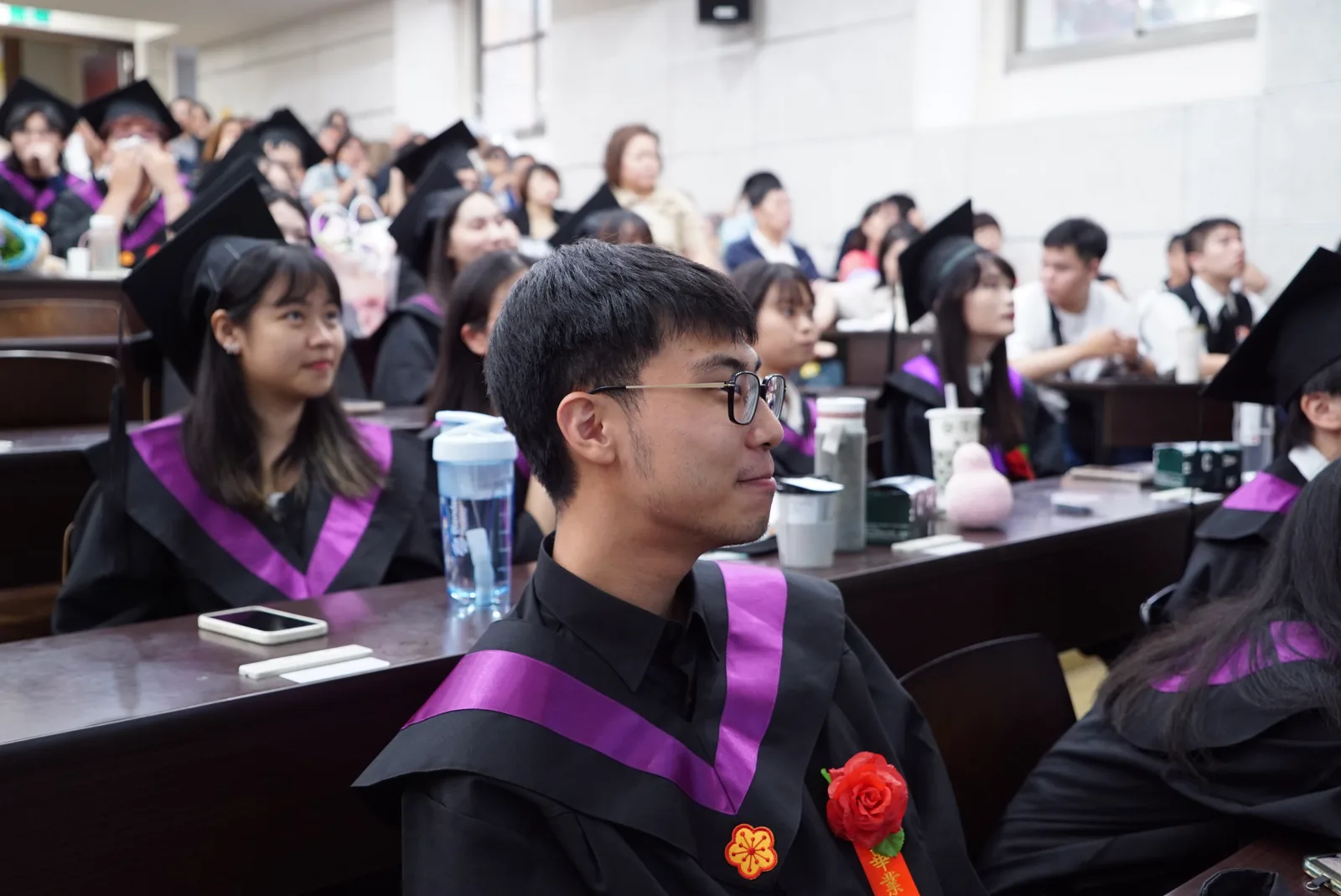
It wasn’t until after the ceremony that I realized: a culture in which anyone can take the podium is not something to be taken for granted. It requires many invisible yet essential conditions before it becomes possible.
What follows is what I had saved in my notes.
Hello everyone. I’m Patrick.
In four years at the Sociology Department, I’ve often felt that this is a discipline built on conversation. We practiced speaking with classmates in Introduction to Sociology, sharing half-formed ideas; we walked out of classrooms for research methods fieldwork, talking to strangers one by one; and there was, of course, the endless dialogue between sociology students and the theorists who came before us.
We began to discover that conversation is not easy. When we tried to explain to people around us what we’d learned — what sociology even is — we’d sometimes get back: “So what kind of job does that get you?” When we tried to discuss social issues with others, we had to decide: should we really explain, or does this person just want someone to listen?
And yet, we never gave up on conversation. We spent long hours at study sessions, working through dense theoretical texts while catching each other up on our lives. We built a kind of open square where anyone could take the stage — whether the story was joyful or sorrowful, it was worth sharing. We held reading groups that required no prior reading to attend, where anyone could come and talk about what mattered to them lately. In the end, we built a community.
Conversation also taught us to care. Because we came to know there are vulnerable people around us, we learned to use more inclusive language — to make space for everyone nearby to feel at ease. Some of us entered the arenas of policymaking: to research, to advocate, to push for reform, trying to build better lives for the people we cared about. We wrote in rooms, debated at tables, spoke on street corners — each in our own way opening one conversation after another, then inviting others to act. Letting conversation become action.
Looking back, the reason I was able to arrive here may have been exactly these small, ordinary conversations — the ones that happened alongside all of you, in the Sociology Department.
Now, gratitude.
To the lunch brothers (午餐兄弟) — meeting you has been one of the great fortunes of this time.
To the friends I met through NGOs and civic communities — you always made me believe another world is possible.
To every encounter in classrooms, communities, and homes.
And lastly, to my family — especially my parents. Even when you said you sometimes couldn’t understand the world I was seeing, you supported me in your own way, without reservation.
Happy graduation, everyone. We’ll meet again, somewhere along the road.