“So you’re really interested in this place.”
After a string of questions, that’s what the old man said to me.
On the first day I landed on Matsu (馬祖), everything I saw filled me with wonder. As it always goes when entering unfamiliar territory, I instinctively compared what I was seeing to the culture I knew. The army markings in bright green and chestnut brown. Sunlight carrying the humidity of the sea. Roof tiles held down with bricks. I could sense that Matsu’s cultural landscape shared something with the main island of Taiwan — and yet I could just as easily point to what was different.
Language too. I had known before coming that the local dialect was Eastern Min (閩東話, Mǐn Dōng), related to Southern Min (閩南語) but mutually unintelligible. One of the things I’d set out to do before arriving in Matsu was to find someone who still spoke Eastern Min — and if possible, ask them to teach me a few phrases.
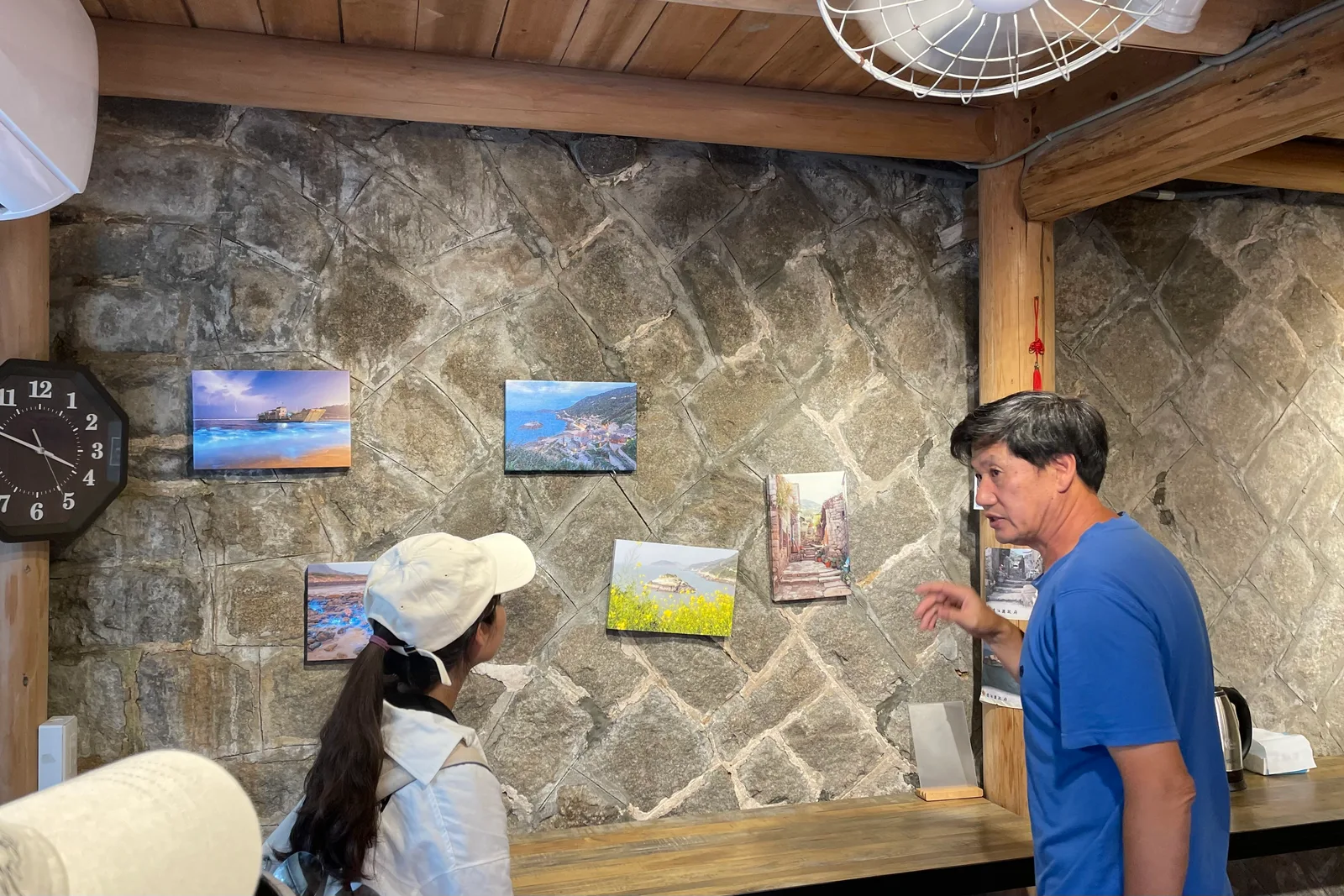
Perhaps the god of Matsu was watching over me. Not long after landing on Beigan Island (北竿), we decided to go buy sweet potato dumplings (地瓜餃, dì guā jiǎo). We arrived at an old shop in the Qinbi (芹壁) village, and I heard the male proprietor and his wife chatting in a language I didn’t recognize.
“That’s Eastern Min!” I thought, eating my sweet potato dumpling. Eventually my curiosity won out, and I went over to strike up a conversation with the old man.
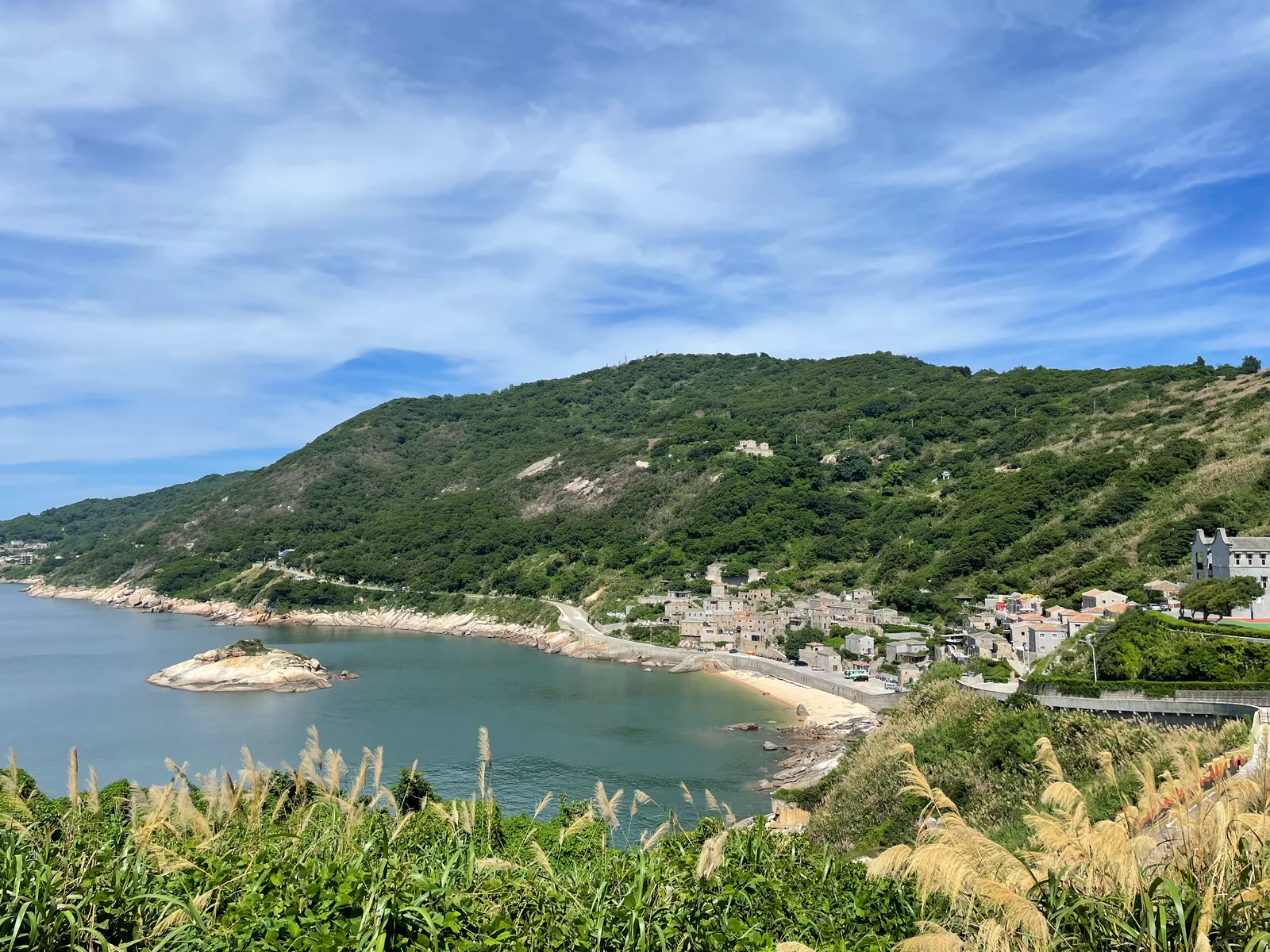
The old man was the village chief of Qinbi, and his wife beside him had come from elsewhere. He told me the name Qinbi (芹壁) comes from Eastern Min: qin (芹) means turtle island, and bi (壁) means “the back.” So this small coastal settlement sitting behind the turtle island came to be called Qinbi.
Seeing that I was interested in language, he opened his phone and shared a video introducing the dialects of different parts of Fujian Province. He added: even just within Fuzhou, there’s Southern Min, Eastern Min, Northern Min, Central Min, and Hakka — it is a place of extraordinary dialectal diversity. Cross one ridge, and people may speak an entirely different dialect.
Several hundred years ago, people from the Eastern Min coastal areas gradually migrated to Matsu, which was then a fishing village, and Eastern Min became the main language spoken there.
Mandarin is called pīnhuà (平話, “plain speech”) in Eastern Min. When the Nationalist government (國民政府) retreated to Taiwan, it began implementing language policies to unify the local population. The old man told me that when he was a student, only Mandarin was taught in school; Eastern Min could only be spoken once you stepped outside.
In the late Qing Dynasty, during Yuan Shikai’s rule, this building had been a money exchange shop — residents could bring gold or silver coins here to exchange for paper currency. The old man said the house was built in the late Qing period; buildings from that era placed a cross-shaped central beam in the middle of each floor to bear the weight, which meant they couldn’t be built very tall — two storeys was the norm. Materials were all locally sourced, mostly granite, similar to the building materials of the fishing villages across the strait in Fuzhou. To guard against earthquakes, the outer walls were built with a five-degree inward tilt, which helps channel seismic energy into the structural beams and leaves enough flex to prevent collapse.
The Qinbi settlement is divided along the central road into North Gate Village (北門村) and South Gate Village (南門村). The old man’s shop, Yunji Commercial Firm (雲記商行), is in South Gate Village. North Gate Village is the more lively of the two; he recommended four buildings worth seeing: the Fruit House, the temple, Qinbi 101, and the visitor center.
The Fruit House is my own name for it — what makes it special is the carved fruit decorations along the eaves: pumpkin, pomegranate, orange, and peach. Pumpkin for prosperity; pomegranate for many descendants; orange for great fortune; peach for long life. Qinbi 101 is the only three-storey building in the village.
In the old man’s childhood, sweet potato dumplings were only eaten at New Year. The dough mixed with sweet potato, filled with peanuts and sugar — simple and delicious. Peanuts and sugar were hard to come by back then, so it was a rare luxury. Nothing like being able to buy them at a roadside stall today.
Then the grandmother sitting nearby, who was wrapping dumplings, joined in. She mentioned she had served as village chief thirty or forty years ago, and later became the first chairperson of the Community Development Association.
“Let me teach you a folk verse — so you can learn the four counties and five islands.”
Beigan Nangan, cup by cup, drink it up (北竿南竿杯杯乾)
Dongyin Xiyin, drink every day (東引西引天天飲)
Juguang Juguang, one shot and you’re lit (莒光莒光一舉就光)
East Island, West Island (東島西島)
She taught me word by word, again and again — and before long, I could recite it easily.
Islands, alcohol, warmth between strangers. Like a kind of prophecy: it was only after leaving Matsu that I understood — some impressions stay with you for a very long time.