Grandma
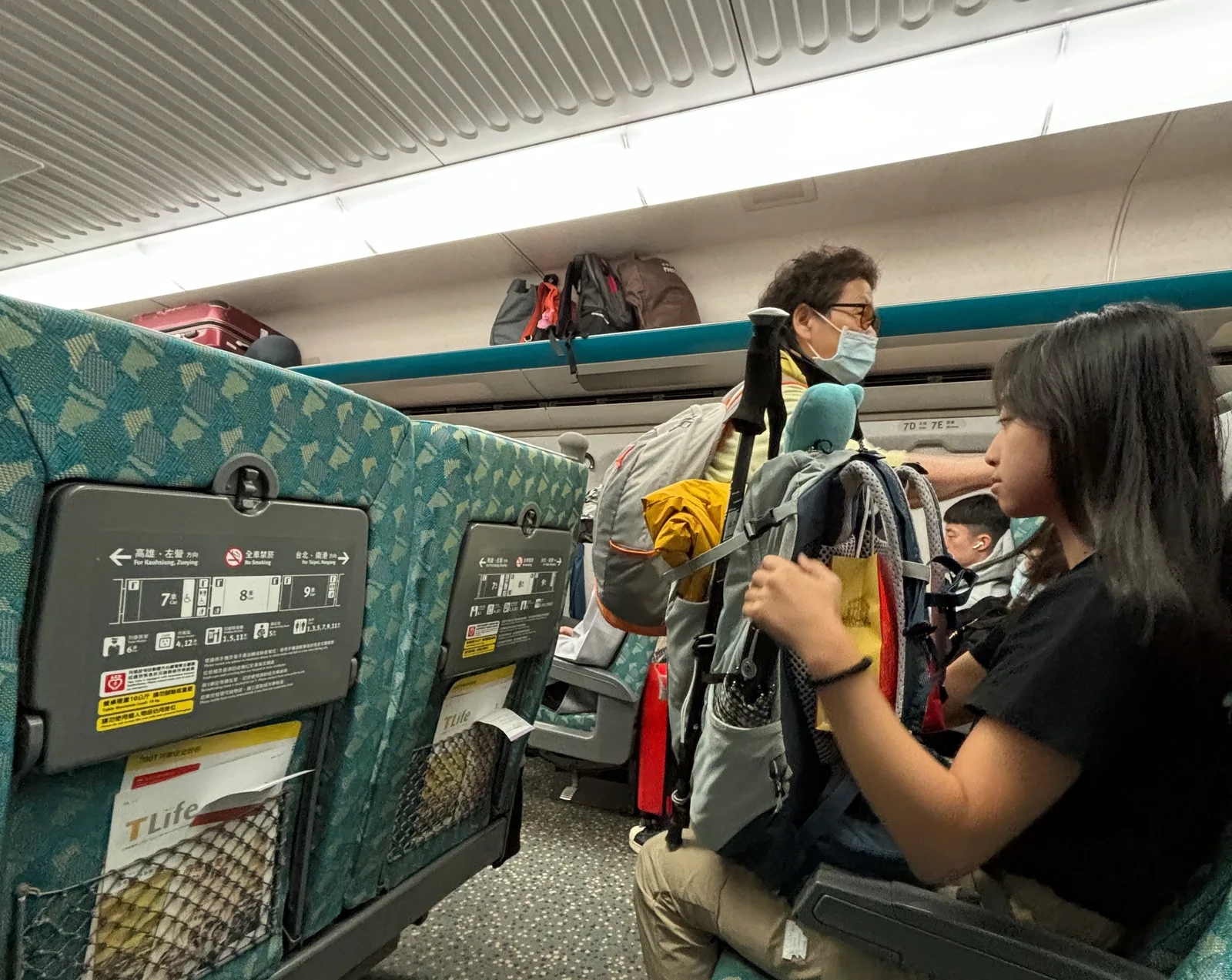
A Monday morning, heading north on the high-speed rail. Car eight, row A — exactly the seat I’d been hoping for: window side, sheltered from the east-facing sun, close enough to the door to exit quickly.
When I boarded, someone was already in the seat beside me. Visually she looked like an older woman — sunglasses clipped onto her dark brown hair, face mask on, a gray leisure bag and a paper shopping bag set in front of her.
“What station is this?” Before I’d even sat down, she asked urgently.
“Taichung.”
A moment later, she struck up a conversation on her own initiative, mentioning she was heading to Taoyuan. For some reason I had an instinct that she was someone who wanted to talk to someone, and decided to slip into good-grandson mode and have a proper conversation with her.
Are you catching a flight? She said she was going to Bade (八德), a district in Taoyuan, to see an old friend for the last time — they’d known each other for over sixty years, such a long time. She had originally planned to visit her younger brother in Yunlin and then return to Kaohsiung, but got word that morning and had hastily changed her ticket to come here instead.
She heard I was at NTU (National Taiwan University). Immediately she asked whether I was very studious, and what kind of work I was planning to do after I entered society. Her grandson went to National Changhua University of Education and Ocean University, she told me — studious people are all smart. For me, this kind of question from an elder was nothing new; I had no particular reaction against it. In fact, the older I get and the more history I learn, the more I find I can understand their generation. For them, being studious meant the family had enough to get by — they didn’t have to live by physical labor. What charmed me, really, was the grandmotherly warmth behind the question.
She lives in Kaohsiung now, with her second son. Before that she was in Pingtung, and only left when her eldest son passed away — her second son came to bring her. The eldest had died last year; the year before, her husband had died. In her words I could hear a deep sadness and regret. I didn’t quite know how to comfort her, but she seemed to have come through it — she still teared up a little when the subject came up.
Do you know how to get to Bade from the station? She pointed to a sticker on her left shoulder — a passenger assistance service. She had developed macular degeneration; her vision was very blurry. Honestly, even as we talked, she couldn’t quite see my face — only a rough outline. She said luckily this service existed. She didn’t dare go out on her own much anymore; she worried that if something came up unexpectedly, she wouldn’t know who to ask for help. With a service like this, she felt more at ease.
The Port
She described in detail the part of Kaohsiung where she lives now, but I didn’t recognize any of the street names. I nodded along. Then she shifted, and began talking about her husband.
Her husband had worked in ship-breaking industry at Siaogang (小港) in Kaohsiung. In the 1970s, to meet the enormous demand for raw iron needed for the Ten Major Construction Projects (十大建設), ship-breaking emerged rapidly as a private industry, supplying the government with scrap steel recovered from dismantled ships. At its peak, over forty percent of Taiwan’s raw steel came from this industry, Taiwan briefly became the world’s largest ship-breaking nation, and Kaohsiung became the center of it all.
Ship owners would bring vessels into port; workers were divided into sea teams and land teams. The sea team went aboard to cut and dismantle parts; the land team handled transport and sorting. It was grueling work — long hours in direct sun, completely physical.
In 1986, the industry was at its peak. That same year, the Jia Na Li (加納利號), a vessel decommissioned during the Iran-Iraq War, sailed into the Daren (大仁宮) ship-breaking dock. As on any ordinary day, workers began cutting steel plates from the hull. What they didn’t know was that residual oil in the bottom tanks had not been fully removed. A spark from the cutting torch hit the bottom — and the ship exploded. She said that at the time she was living in Caoya (草衙) — you could see pieces of the ship flying through the air from the road. A man nearby who’d just finished eating at a food stall and stood up to leave had his throat cut by flying shrapnel and died on the spot. If only he’d eaten a little slower.
Her husband was on the ship. Flames spread, smoke billowed — he crawled his way off. Fortunately, only minor burns on his arm.
After that the industry gradually declined, and within a few years the government shut it down. Ship-breaking later moved to China. The Chinese came to Taiwan looking for workers at first, learned the skills, and then let them go. That’s just how China operates.
“Well, at least after that he didn’t have to work so hard anymore.”
Sand Hill
“Things were harder back then — not like your generation, with nothing to worry about for food or clothing.” With a large field to tend, after finishing primary school there was no choice — she had to go home and help with the farming. She had seven sisters and three brothers; the house was full of life.
“Back then, my father was taken away. So was my grandfather, and my uncle.”
They were victims of the February 28 Incident (二二八事件). Because members of the family had political connections in the local community, they were designated as rebels; a sweep of male relatives were arrested. She was three years old at the time, and watched her twenty-four-year-old father and eighteen-year-old uncle be taken away by the police.
Her grandfather was sent directly to Machangding (馬場町) to be shot. “More than three thousand people were killed there,” she said. Because there were so many to execute, they would fill the wounds with sand (沙, shā) to stop the bleeding and set the bodies aside. Over time, the motionless piles of them became a mound of sand — sā lún (沙崙).
Her father and uncle were imprisoned for a few years. She had heard her uncle recount how he was hung up by his interrogators and beaten until he was exhausted and lost consciousness — at which point they would douse him with water, and begin again.
She set down this heavy history quietly. The government apologized later — during the Ma Ying-jeou (馬英九) era, a White Terror memorial was built, and eventually compensation was paid.
Is it really all right? I wanted to ask, but didn’t.
Family
Her eldest son died of cancer. By the time he was diagnosed, it was already stage four. In and out of hospital for chemotherapy — her son told her it felt like ten million tiny insects stinging your body, burning and itching at once. His wife bore most of the caretaking; her grandson took a leave from school to come home and help. More than three years of this. It was so hard. She wished Taiwan had euthanasia (安樂死).
At least the friend she’s visiting today in Bade — she entered the hospital, and ten days later passed away in her sleep, without pain.
She said young people these days don’t want to get married — her grandson and her friends’ children all refuse. Such a pity. She asked if I had a girlfriend. Not yet.
“You really should get married — it makes life happier. Being alone is too boring. Let me tell you: work was very hard back then, but when I came home and saw the children, everything improved. It’s really different!”
In the face of the old woman’s animated expression, every piece of sociology and anthropology I had ever learned about gender became entirely useless. I just listened — to one person telling me how family and children had shaped her life, the difficult and the happy moments she had lived through.
“Taoyuan station.”
Like waking from a half-dream, she arrived.
Every grandmother is a recent history, I thought to myself.