“Today we’re going back to grandma’s house.”
Grandma’s house is a three-storey townhouse in Litóu (犁頭店, now Nantun District, Taichung). Since I was born, all my memories in that house have revolved around her — the figure busy in and out of the kitchen during the holidays, the person I’d talk to after primary school let out, the one who always looked at everything with optimism.
Why only grandma? My grandfather has always been an absent presence in my life. When I was one year old, he suffered a sudden cerebral hemorrhage. After years of rehabilitation and more than a decade bedridden, grandma stayed by his side the entire time until he passed away. She then became the head of the family, holding the whole extended family together.
“It’s all ūn-miā (運命, fate’s) arrangement.” In an era when fate came before life and responsibility outweighed choice, a woman’s destiny was bound tightly to her family. Her story can fill in a few of the missing fragments in a history dominated by men.
I. The Eldest Daughter
My grandmother’s full name is Wu Qionying (吳瓊瑛). She was born in the twentieth year of Shōwa (昭和)1 in the Lunzaiwei area of Tainan (崙仔尾, now Rende Township, Tainan). Her own grandmother had six children — five daughters and one son — and grandma was the eldest daughter.
The days of hiding in bomb shelters during World War II air raids had just ended2, and the Nationalist government (國民政府) arrived in Taiwan. To consolidate its political power3, it implemented a series of land reform policies. In 1953, Chiang Kai-shek issued an executive order promulgating the “Land-to-the-Tiller Act” (實施耕者有其田條例). The Wu family, previously tenant farmers, was able to acquire a large piece of land at a very low price4. From that point the family became landowners, and their circumstances gradually improved. Grandma said that in those days, everyone went to school barefoot; she had shoes to wear every day. Her father even bought her a pair of high-top shoes once — tsiok-phānn (很時髦), she said. Very fashionable.
At that time, grandma’s own grandmother bore much of the agricultural work. Before dawn she had to start preparing meals for the farmhands; through the day she would go to the fields to supervise and work alongside them. As the eldest daughter, grandma had to help share her mother’s load. Every morning she not only helped cook, but also carried the feed — made by boiling sugarcane leaves — to the pigs, and only after finishing all of this would she walk to school.
After graduating from Xinhua Junior High School5, grandma worried about the many younger siblings at home who still needed to be supported, and decided to go out and earn money. Because her father knew the Rende Township mayor at the time, a position as a clerical assistant in the township finance office was arranged for her. For the demands of the work, she proactively enrolled in professional courses at the Tainan Commercial School67, learning accounting, the abacus, and other skills. When I asked whether she really had to go study that, she said: “Property tax requires calculating penalty interest — you have to multiply it. If I didn’t know how to use an abacus, how could I do the job when people came to me?”
In the postwar period, the Nationalist government’s support policies accelerated the rapid growth of the cotton and linen textile industry; by the mid-1940s, Taiwan had achieved self-sufficiency in cotton textiles8. To absorb the surplus production capacity, the government began pushing cotton textile exports9.
Learning that a nearby textile factory — the Guofeng Textile Mill (國豐紡織廠)10 — was offering higher wages, grandma decided to leave the familiar world of finance work and go to the factory alone as a female laborer. Eight hours a day, no breaks; she worked continuously at the noisy looms.
II. The Bride
Not long after, a neighbor introduced a colleague to grandma. His surname was Zhong, his given name Jieshan (鍾介山). He worked as a technician at the Cotton and Linen Research Station (棉麻試驗所)11. He came to visit the family, and her family liked this man very much — “tall, with long fingers,” they said — and noted that his philtrum was long, which meant he would live longer.
At that time, grandma’s own grandmother said to her: “A girl’s life is like chives — the lucky ones marry into luck. No need to be too choosy.”
On the day of her marriage, grandma left the familiar Jia-nan Plain (嘉南平原), crossed the Zhuoshui River (濁水溪), and arrived for the first time at her husband’s family home in Yuanli Township (苑裡), Miaoli County — a place she had never been. When she stepped down from the sedan chair and saw the earthen-brick house (塗墼厝)12 on the mountain, thatched with straw, she felt at a loss. She had stepped into an unfamiliar Hakka village (客家庄), where the people of her new husband’s family spoke a language entirely foreign to her. Nothing was what she had expected. She didn’t know how her future life would unfold.
The family who had come with her were equally speechless. Her parents, furious, told grandma’s grandmother: from now on, our children will decide for themselves who they marry. But no matter what was said, it could not change the fact of a daughter’s marriage.
Only then did grandma understand why grandpa had never allowed her family to visit his home before the wedding — why he had never mentioned being Hakka, and had never brought up the fact that he had five brothers. “I was deceived by your grandfather,” grandma said, both indignant and amused.
Like a stalk of chives cut from the ground and transplanted, hard and sudden, to a distant hillside.
III. The Mother
Grandpa worked as a technician at the Cotton and Linen Research Station, from morning until night; what he earned was still considerably less than grandma. Later, grandma’s uncle introduced grandpa to a job: going door to door to collect water bills for the water company. At first grandpa didn’t want to do it — he didn’t know how to handle money. Grandma sat down seriously with him and said: “If you don’t take this job, you’ll never have the chance to be promoted. You’ll always be a technician.”
Grandma came up with a method. Each day she sent grandpa out with a large cloth bag: he would go to each house, collect the money, make the correct change, and put everything into the bag. At night, he would hand it to grandma, who would prepare the tax receipts and income-expense reports for him to take back to the Water Bureau the next day. With grandma’s persistent encouragement, she eventually talked him into taking the job.
In 1972, Taiwan Provincial Governor Hsieh Tung-min (謝東閔) launched the “Living Room as Factory” (客廳即工廠) campaign, encouraging factories to subcontract work to housewives in nearby areas, increasing productivity at home to meet the surge of export orders.
Around the same time, my uncle and my father were born. Grandma left full-time work to care for the family. Through a neighbor’s referral, she took on a significant amount of piecework — knitting American export sweaters13 — so her days ran like this: during the day at home, watching the children while working on the knitting; at night, managing the water bill accounts for grandpa. Day after day.
That same year, Premier Chiang Ching-kuo (蔣經國), in his instructions on key measures for sound urban development, directed: “To effectively develop public water supply across regions, a province-wide water company shall be established immediately to operate under unified management; simultaneously, the long-term development plan for provincial water supply shall be accelerated, so as to concentrate limited human and financial resources, raise investment efficiency, and reduce operational costs.”14
On January 1, 1974, the Taiwan Provincial Water Corporation (臺灣省自來水股份有限公司) was formally established, incorporating 128 waterworks across Taiwan Province and Kaohsiung City in three phases. At this point, grandpa was promoted to a civil official position and transferred to the Taiwan Water Corporation’s headquarters. The whole family moved to Taichung, settling in the Litóu area. Both my uncle and my father went through their entire schooling in Taichung — primary school, junior high, and high school. During this period the family’s finances were still not comfortable, but they got by.
“Actually, our genders should have been swapped — I should have been the boy,” grandma said, noting how different her and grandpa’s personalities were. Grandpa was gentle, soft-spoken, even-tempered, and attentive to the children. Grandma was direct and decisive, able to make decisions with conviction, skilled at planning and organizing — but by comparison, less patient with the children.
Two people who defied traditional gender roles, complementing one another, continuing to protect the family.
IV. The Partner
In 1984, the Labor Standards Act (勞動基準法) came into effect, changing occupational retirement pensions from a self-contribution savings system to a lump-sum payment, replacing the previous monthly pension with a one-time payout15. The accompanying wage reforms raised grandpa’s monthly salary from around ten thousand NT dollars to nearly forty thousand — almost double. Suddenly the family’s financial situation improved, and the years of tight constraints were behind them.
Life kept moving. In the blink of an eye, the first grandchild was born; grandma resigned to focus on caring for her. Grandpa reached retirement age, and the two of them began the comfortable years of enjoying their grandchildren.
1994, The year after I was born.
That day began like any other. Grandma rose first in the early morning and went for her morning swim. When she returned, she and grandpa switched off — he went swimming while she watched the grandchildren.
Around midday, while in the middle of minding a child, she suddenly received a phone call from her second son. She heard that her husband had collapsed at the swimming pool, had been rushed to the intensive care unit, and needed to go into surgery immediately. She hung up, and the world started spinning.
The diagnosis: sudden cerebral hemorrhage (腦溢血)16. Because surgery came in time, grandpa was pulled back from the edge. But he could never fully recover, could never return to the life he had known before. The grandma who had always been cheerful fell into a low, saying nothing. My parents were so worried about her that they asked her to come stay with them for a time, to make sure nothing worse happened.
One day, my parents suddenly noticed a complete change in grandma’s state — no trace of shadow on her face; it was as if they were seeing the original bright and positive her again. When they asked what had happened, she said: “One person in the family collapsing threw everything into chaos. I want to take good care of myself, so my sons don’t have to worry.”
After that came years of continuous rehabilitation and bed rest. Grandma stayed by grandpa’s side the whole time — taking him to hospital, wheeling him to the nearby park, feeding him, talking with him — until grandpa passed away.
Eleven years. Long days that felt, in the end, like a single instant.
Postscript
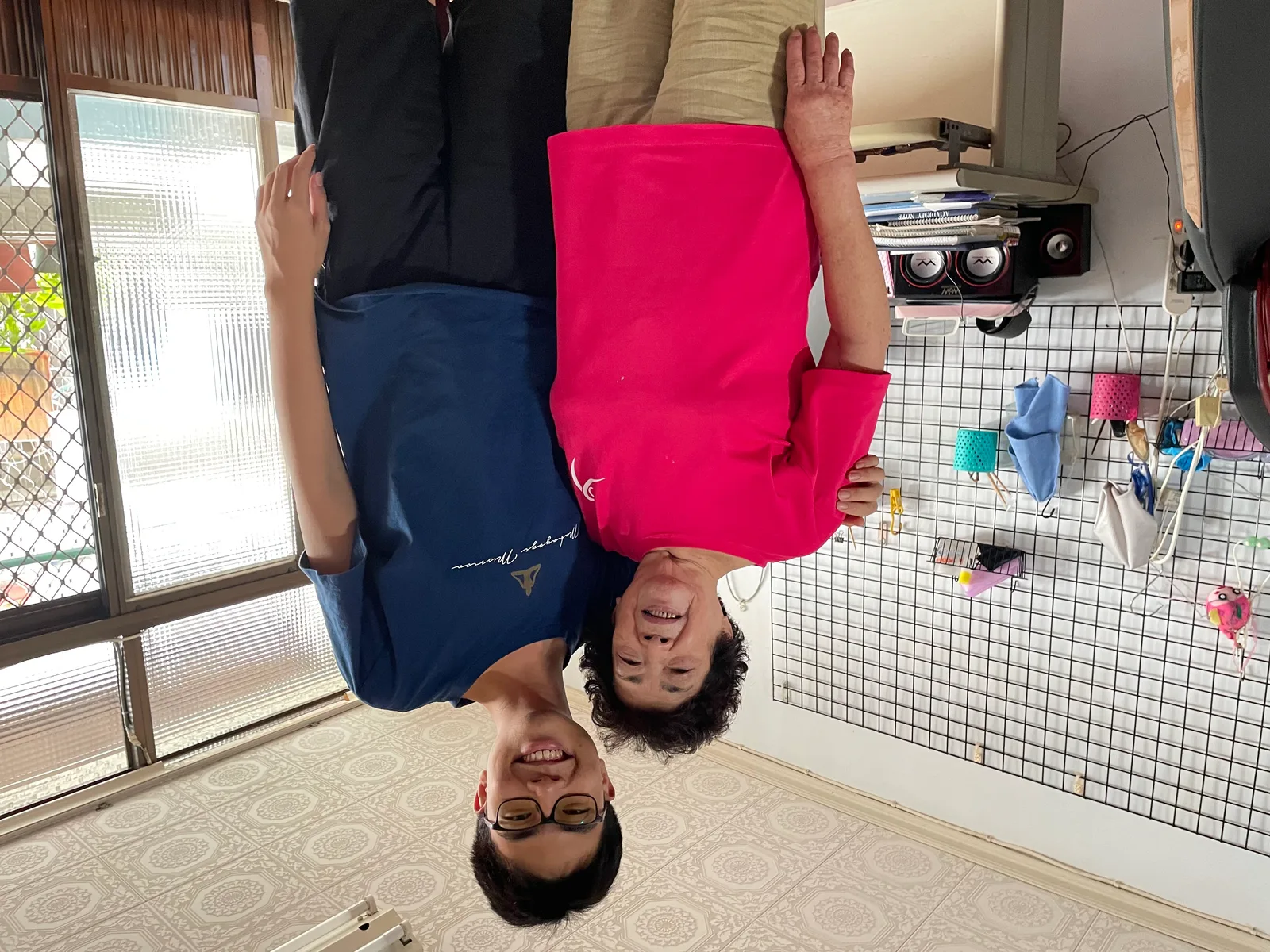
During Qingming (Tomb-Sweeping Day), I went back to grandma’s house and sat with her, listening to her share memories from the past. The three-storey townhouse now holds only grandma living alone. “The solo life is so free,” she said — she finally has more time to take care of herself.
“So what does home mean to you, grandma?” That’s what I asked at the end of our last conversation.
“Family is my center.”
Before I left, grandma reminded me not to forget to take the spring rolls she’d made. If I came back next time, I should tell her in advance so she could prepare something good.
We walked back into our separate daily lives. And at the altar table by the door, the incense sticks kept burning.
Footnotes
-
The 20th year of Shōwa corresponds to Republic of China year 32, or 1943 CE. ↩
-
According to the United States Strategic Bombing Survey (USSBS), between 1944 and 1945, Allied bombing of Taiwan caused 1,367 deaths, 217 missing, 960 seriously injured, and 1,406 lightly injured in Tainan alone. ↩
-
The purposes behind the Nationalist government’s land reform policies are debated, but most scholars see them as primarily aimed at consolidating political control over Taiwan — one view holds it was meant to weaken the power of Taiwan’s local landowners and prevent them from instigating revolt; another sees it as a political statement to compete with the PRC for leadership of China’s modernization. See Liao Yan-hao and Qu Wanwen (廖彥豪、瞿宛文), 2013, “A Land Reform That Also Protected Landlords,” pp. 126–127. ↩
-
The 1953 “Land-to-the-Tiller Act” and the “Taiwan Provincial Physical Land Bond Regulations” allowed landlords to retain between 7 to 12 jia (甲, approx. 0.97 hectares) of rented paddy land, or 3 jia of paddy field. Rented land above the retention limit was compulsorily acquired. Beneficiary recipients were current-cultivating farmers; the acquisition price paid to landlords matched the compensation formula. Recipients were to repay the land price in equal annual installments over 10 years, at 4% annual interest. ↩
-
At the time, the Republic of China had implemented six years of compulsory education. Most female classmates did not continue past primary school; grandma also faced opposition when she sought to enter junior high school, but her grandfather insisted, and she completed junior high. ↩
-
Now the National Tainan Senior Commercial and Vocational School (國立臺南高級商業職業學校). ↩
-
In 1961 (Republic of China year 50), the Taiwan Provincial Tainan Commercial Vocational School established a skills training center, offering courses in accounting, bookkeeping, the abacus, Chinese typing, and more, to train working youth and supplement regional vocational education. (School history, National Tainan Senior Commercial and Vocational School.) ↩
-
By 1955 (Republic of China year 44), Taiwan’s cotton yarn and cotton cloth production had both reached self-sufficiency. See Qu Wanwen, 2008, “Revisiting the Early Development of Taiwan’s Cotton Textile Industry,” p. 179. ↩
-
These measures included the 1954 “Regulations for Refunding Import Duties on Raw Materials for Export Goods” and the foreign exchange and trade reforms of 1958–1960. See Qu Wanwen, 2008, “Revisiting the Early Development of Taiwan’s Cotton Textile Industry,” p. 180. ↩
-
Originally the Shintoyo Textile Company’s Xinhua Factory (日治時期臺灣織布株式會社新豐廠) during the Japanese colonial period; after the war it was absorbed into the government-run Taiwan Industrial and Mining Corporation and became the Xinhua Textile Mill. In 1956 (Republic of China year 45), it was renamed the Guofeng Textile Mill. ↩
-
The Tainan Cotton and Linen Research Branch Station (臺南棉麻試驗分所), responsible for crop variety research and cultivation technique improvement; it closed in 1978 (Republic of China year 67). ↩
-
A house built from compressed earthen blocks (土塊). ↩
-
At the time, sweater processing was concentrated mainly in Tainan; garment processing mainly in Taipei County (now New Taipei City), Yilan, and Taoyuan; and shoe processing mainly in Taipei County and Tainan County. See “Beating the Recession: Home Piecework Makes a Comeback,” United Daily News, January 31, 2009. ↩
-
Taiwan Water Corporation official website — Introduction. https://www.water.gov.tw ↩
-
See the Labor Standards Act and its Enforcement Rules. ↩
-
Commonly known as a stroke (中風). ↩