(To protect those involved in this space, all names in this article have been changed.)
Dinner
The most familiar stretch of road in Utrecht runs from Science Park, along the brick-red cycle path through the canal park, past the bars on the main street, through the underpass beneath the central station, past a mosque and a church. At the end of the journey is a living room.
My first visit was a Friday evening, half past six — the Dutch autumn still holding onto the light.
You push open the door to rows of long tables. The early arrivals are gathered in twos and threes, talking and laughing. The air carries an unfamiliar spice; the cooks are busy in the kitchen, and the serving bowls are laid out neatly on the tables. I hadn’t forgotten: I was here for dinner.
“How are you?” Barely seated, I couldn’t help but strike up a conversation with whoever was nearby.
“Nederlands?” he asked — do you speak Dutch?
“Engels?” I replied — do you speak English? — as if we were haggling.
He didn’t speak much English. A few attempts, and it was clear we’d hit a wall. I was trying to think of a graceful way to keep the conversation going.
“Français?” he suddenly asked. “Ouais, je parle un peu français” — yes, a little — and slowly, in broken French, something began to open.
Farouk was from Morocco and had lived in the Netherlands for many years. He said he hadn’t spoken French in over twenty years. He came to the living room for events now and then; his other friends would join us later.
What did he think of this place? I asked curiously.
“Très bien,” he said. Very good. That was the only part of his answer I could fully catch.
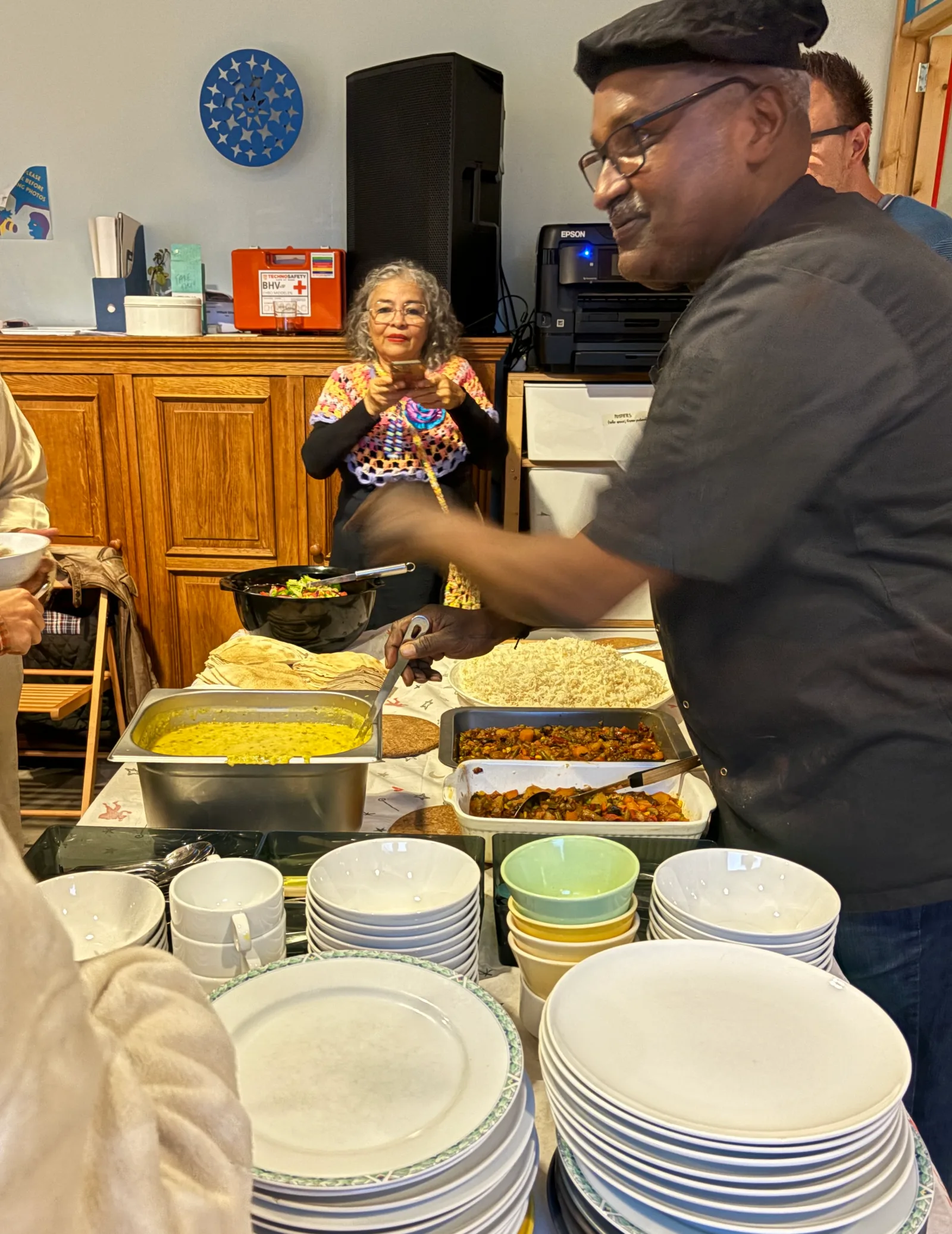
Ding ding ding. The host rang a small bell to announce dinner officially begun. No need to coax anyone — people were already on their feet reaching for their plates.
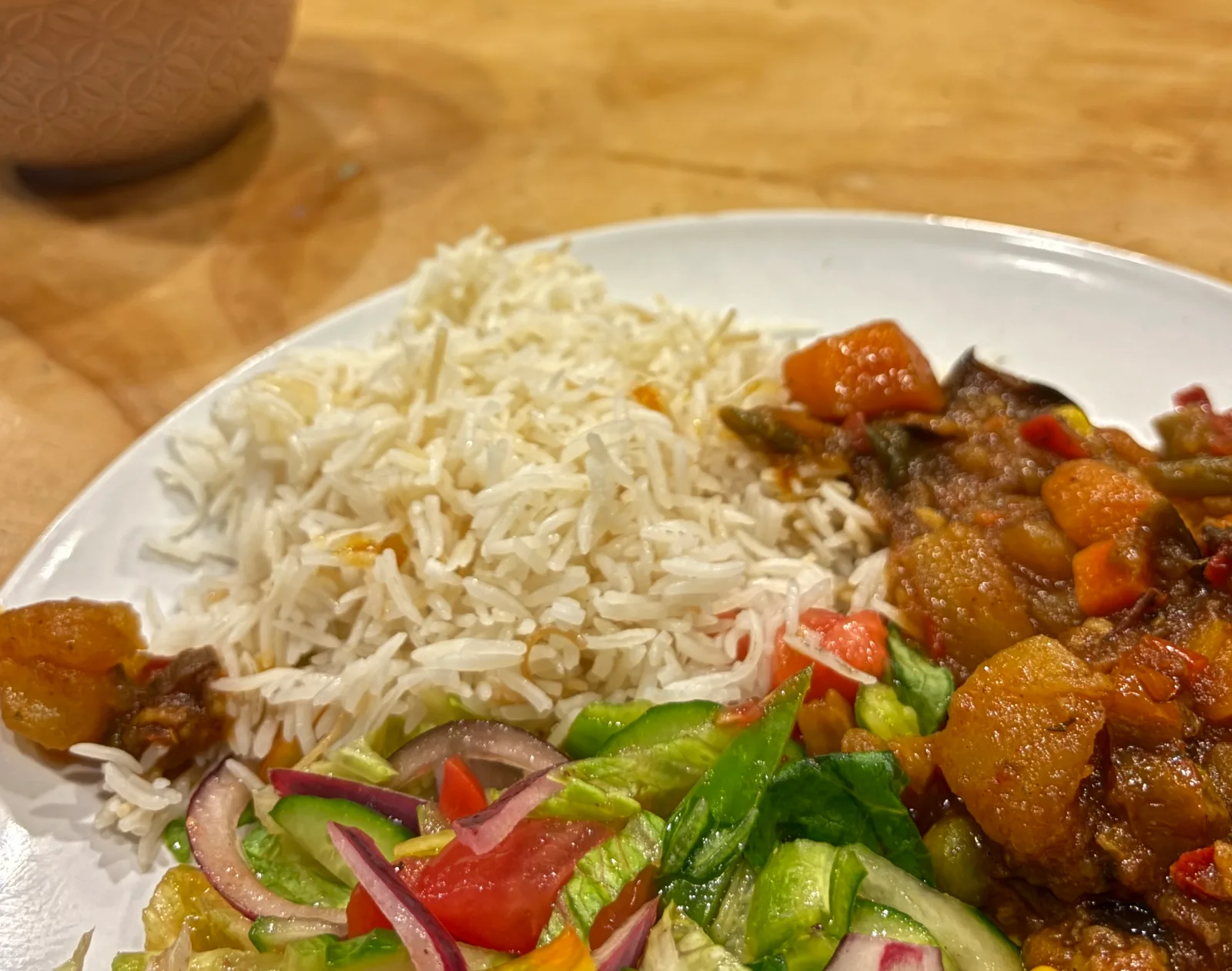
A smooth, golden soup; bright, tangy green salad; a rich stew and flatbread with long-grain rice. The kind of food that makes your eyes well up, it’s so good.
“Welcome to Community Dinner!” Yejide called out with enthusiasm. Beside her, volunteers translated into Dutch and Russian. She said this living room was a place for people of all backgrounds to meet — please be respectful, and don’t forget to talk to the people around you.
“Tonight we have a special group of guests who’ve prepared some performances.” It turned out dinner was only the opening act.
A Ukrainian mother and daughter took the stage. To guitar accompaniment, they moved from lullabies to wartime songs, encore after encore.
An Argentine couple came up next and danced the tango, spinning and sliding faster and faster to the audience’s applause, ending in a flourish to a full-house standing ovation.
“Now it’s time to experience our culture,” a man said as he stepped up and put on some music. The crisp percussion led a driving rhythm; people began rising from their seats one by one, moving freely to the beat. “Patrick, won’t you join us?” Yejide called out to me.
Swaying, turning, holding hands, sometimes slow, sometimes fast, never quite on the beat. No two people moved the same way — but the smiles, somehow, were all alike.
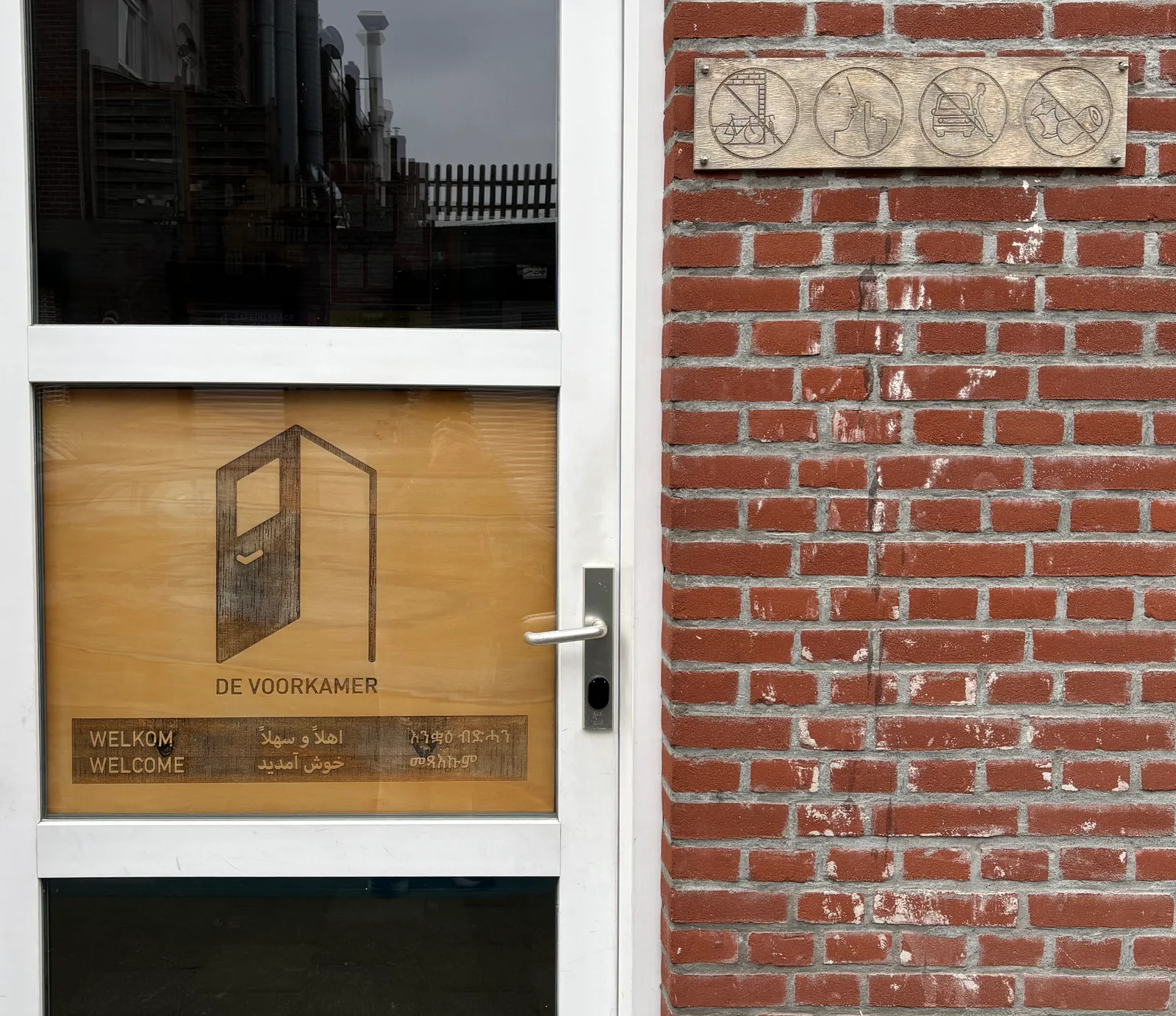
De Voorkamer — Dutch for “living room” — is also the name of this place.
Movement
The neighborhood where the living room sits is called Lombok — a singular kind of place.
For anyone who has lived in Taiwan, the area around a major train station calls to mind a particular image: the immigrant enclaves that cluster in its shadow, the unhoused who rest nearby. Transit hubs are where people converge — a first foothold for the newly arrived, a site of opportunity and hope.
Lombok sits right beside Utrecht’s central station, its fate bound up with movement and poverty. Postwar Netherlands had much to rebuild, and with the urgent demand for labor came wave after wave of guest workers — groups of adult men from Turkey and Morocco who crossed the sea and arrived at the textile factories here, working around the clock in poor conditions.
Bolts and bundles of cloth traveled outward along the railways, just as these men had come from afar.
Across the Netherlands, immigrant communities like this one always had a few schools the locals called “Black Schools” (Zwarte Scholen) — the majority of students came from immigrant backgrounds, and the schools taught their home languages, with the expectation that one day these guests would return to where they came from.
The “black” in the name wasn’t about skin color — it was a boundary line between white and non-white, between European and non-European, between churchgoer and non-churchgoer. Allochtoon was the word used to describe these newcomers: people who grew from another soil.
But in the end, the guests put down roots. And yet the schools remained invisibly segregated — Dutch families wouldn’t send their children to these schools, and economic disadvantage within immigrant communities reproduced itself across generations. The education gap became the community gap.
Even when the Dutch government later tried to close that gap, it was belated justice: a separated generation had already been formed. Today, on the train, you sometimes see people with a certain air about them — playing music aloud, chatting loudly in French, or greeting a stranger on the street for no particular reason. They seem to have written their own rules outside the system, leaving momentary ripples on the surface of what is called order.
History doesn’t stop. The Netherlands grew into a prosperous, peaceful developed nation, and more guests kept arriving. In the last decade, global conflicts have driven many refugees here after circuitous journeys; shelters and asylum centers followed. Walk through these streets today and you’ll find storefronts with Arabic signage, the scent of Turkish kebab in the air, and halal butcher shops that are rare elsewhere in the city.
De Voorkamer was founded in this moment — to meet the need for social integration as large numbers of refugees arrived, by building a living room where newcomers and locals could encounter one another. Everyone who has walked through the door has traveled some distance to get here.
Farzaan picked up my phone and used Google Maps to walk me through his journey. Two years ago, he left a small town in southeastern Afghanistan, crossed the Iranian plateau, traversed the Bosphorus Strait, and made his way across the European continent with a handful of companions to reach this city. As the youngest man in his family, he carried his family’s hopes with him. He spent his last savings — all of it — just to set foot on peaceful ground and begin again.
His hometown is in an area where the Street View camera cannot reach, so we switched to satellite view: a patch of green in a yellow-sand mountain range. He pointed to the buildings one by one — this is the town center, this is my school — and then, the home he cannot return to.
Ramma had fled the shelling of Syria many years earlier, spending time in Turkey and then Germany before finally reaching the Netherlands. His ability to move between several languages is proof of all that movement. As a queer person from a Muslim-majority country, he has had to navigate multiple layers of overlapping challenges at once.
Today, he cannot watch any film involving war. “It brings back too much trauma,” he said. Even from behind a screen, even in a country at peace, the sounds of gunfire and explosions still reach him.
Also fleeing conflict, Alham left Iraq six years ago and made his way alone to Ter Apel, a Dutch border town where asylum seekers first arrive. “I thought I was finally going to have a better life,” he told me.
It took two years of waiting to receive identity documents; work permits restricted him to low-skill jobs; his professional expertise — once in a white-collar field — was seen as a threat to local workers, and he became a construction laborer, moving between cities for the sake of earning a living. “Lately I’ve started thinking about whether to go back,” he said, a quiet helplessness in his voice.
The living room is a place where people meet — and where people tell their stories.
Exchange
Every Monday, I had a standing appointment: Arabic Coffee.
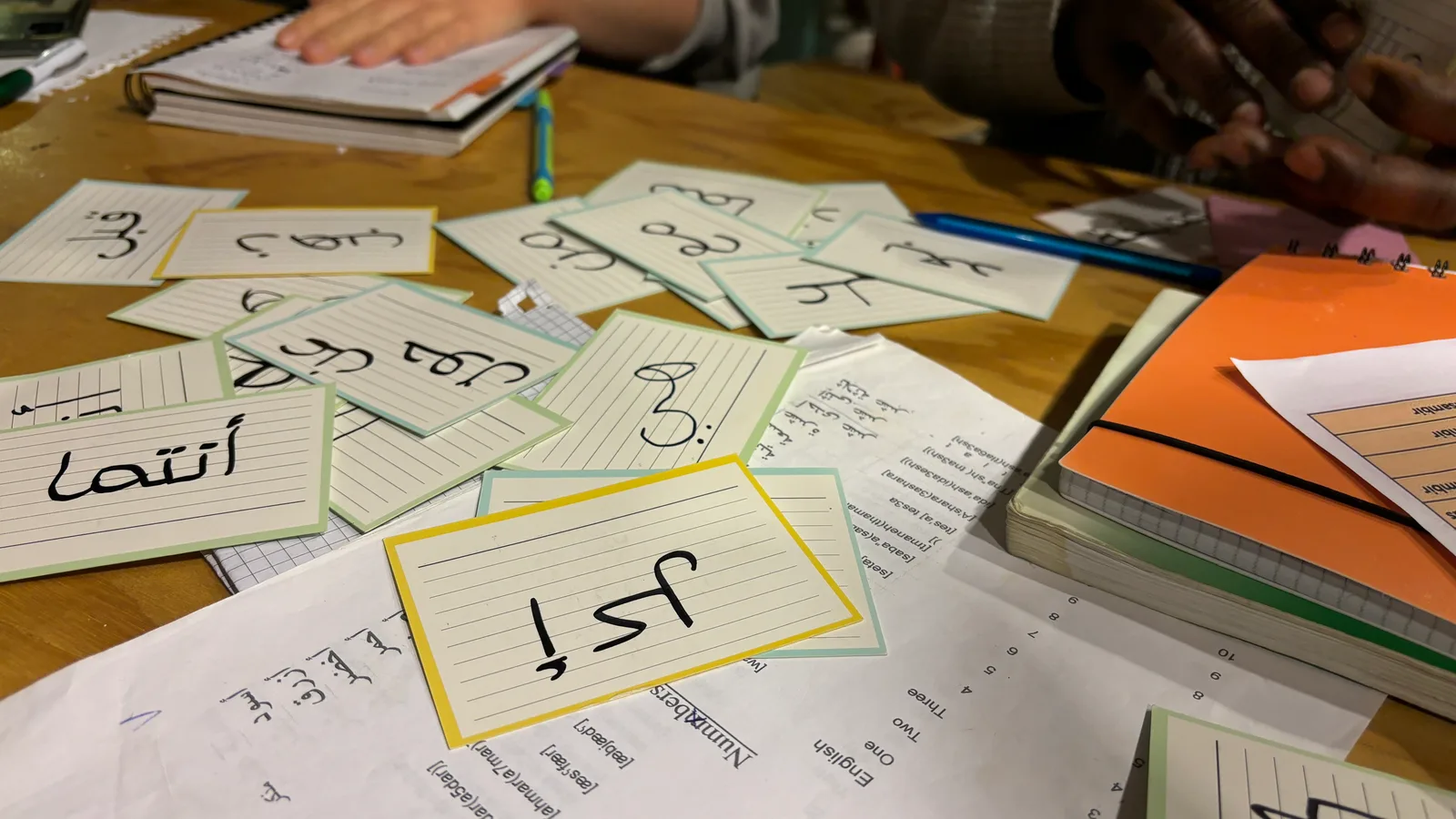
The different tables in the living room represented different levels of proficiency, from beginner to advanced, each with a volunteer to help. Since I didn’t yet know the alphabet, I naturally went to the Beginner Level.
Arabic is a particular kind of language — written right to left, and you have to recognize each letter within a connected string of script before you can produce the correct sound (to say nothing of the vowel markings, which are optional and often omitted). Nor is Arabic a single unified whole: there is Modern Standard Arabic used in formal settings, and then dozens of regional dialects spread across the Arabian Peninsula, the Gulf, and North Africa — often so different from one another as to be mutually unintelligible. (Rather like saying Min Nan (閩南語, a Fujianese language spoken in Taiwan) is the same as Shanghainese.)
An hour and a half passes faster than you’d think. Most of the time was spent trying to pronounce things correctly, learning a handful of phrases, playing a game or two. And then the evening was over.
“Why do you want to learn Arabic?” Wasima asked me one time, out of nowhere.
I told her: traveling in the past, I’d been welcomed with extraordinary warmth by many people whose mother tongue happened to be Arabic. I’d always wondered what kind of culture could shape people like that — people willing to treat a stranger as family, to share everything they had. Learning the language, I said, felt like one way to come closer to them.
Language really is a cross-section of culture. Arabic has sharply marked gender distinctions — the words used to describe a man and a woman are not the same. Friday (الجمعة, al-Jumu’ah) is the day of gathering, when people go to the mosque together. Even greetings differ between Muslims and non-Muslims: Salam (سَلَامٌ) means peace; As-salamu ʿalaykum (ٱلسَّلَامُ عَلَيْكُمْ) is “may peace be upon you” — and to receive it is to receive God’s blessing.
Wasima reminded me, while learning Arabic, not to try to translate every word and phrase into English. “You’re learning a new language, a new culture,” she said. You’ve never studied a Semitic language before — this is a language that grew out of a different soil, one that carries a rich history and belongs to a whole other people. We have to empty ourselves out, open up completely and immerse ourselves. Not interpreting their language through our own worldview — but trying to think the way they think, and from there, beginning to understand their world.
Beyond Arabic Coffee, all kinds of activities unfold in the living room each day.
There’s Dutch Coffee — organized by a group of Dutch volunteers, attended mostly by new arrivals. Elbert is a retired urban sociologist who once conducted research in immigrant communities; after leaving academia, he found another way to give back to the neighborhood. Luna said she simply happened to be free on Tuesday afternoons. “Why not do something for the community?”
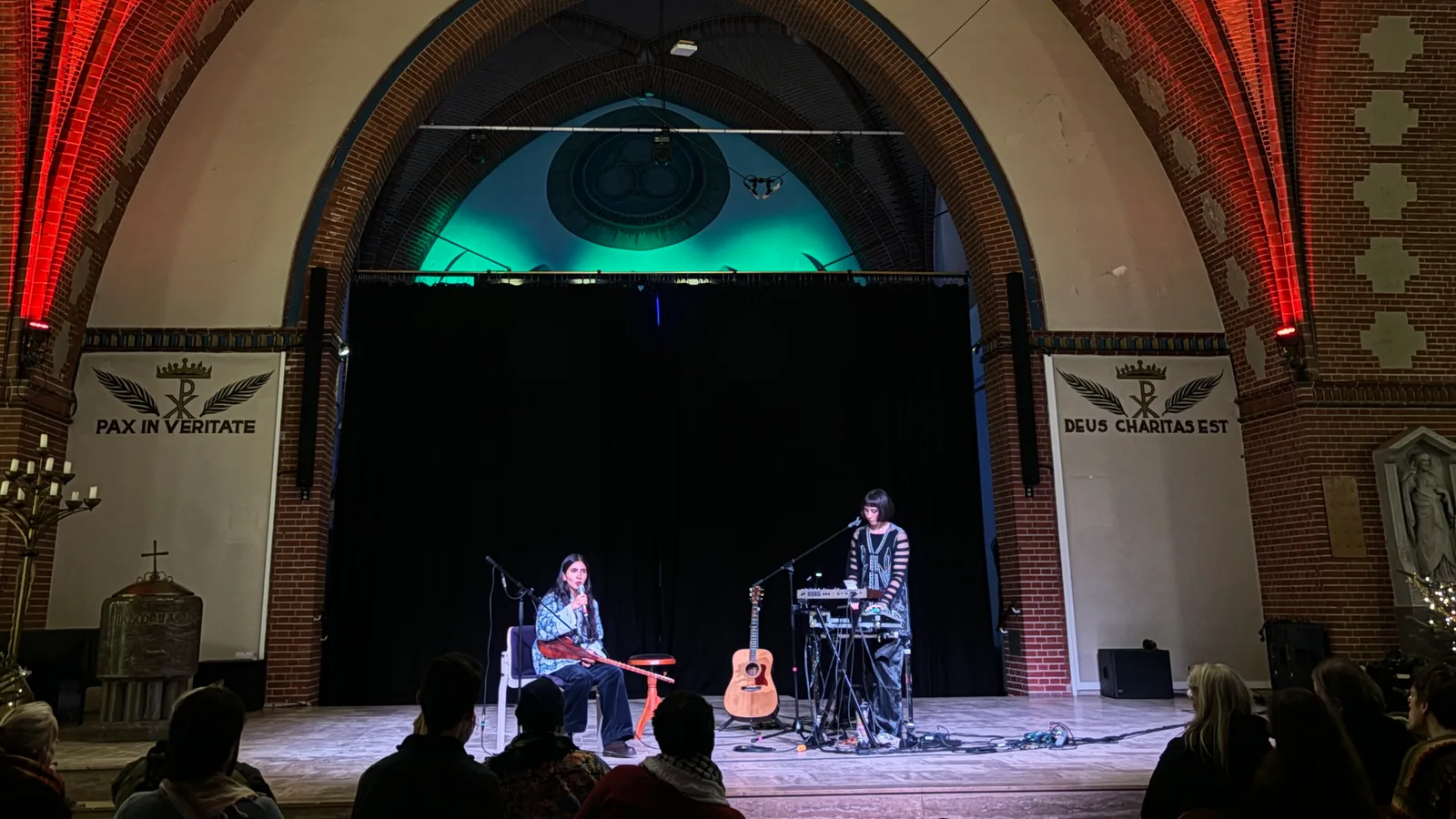
Then there’s Culture Shock — a program that randomly pairs two musicians from different cultural and professional backgrounds and asks them to design a performance together. The session I attended brought together a Syrian and an Italian: the oud (烏特琴, a pear-shaped lute) laid down a melody while the guitar filled in the harmony, layer upon layer, resonating low and long.
Community dinners, walking tours for immigrants, writing workshops — more than I can list.
What struck me most was that the different activities are each organized by their own project group — bottom-up, with community members initiating events themselves, and anyone with an idea is welcome to create something new. Beyond a few paid staff and interns, the living room runs almost entirely on volunteers.
“I’m completely here on my own time — they’ve never paid me a cent,” Ramma told me with pride. He simply loves this place and wants to give more of himself to it. He’s a regular host of Arabic Coffee; a refugee who arrived in the Netherlands, he turned around and became someone who gives back to the community.
The living room is a safe space — holding an umbrella wide enough to shelter everyone, allowing all kinds of groups to gather and hold events, while keeping those groups’ boundaries permeable enough that people can meet and cross between them. Over time, it was no longer only refugees who came: immigrants, feminist organizations, international students, queer communities — the activities branched and grew like something alive.
Women’s gatherings, immigration advice sessions, queer meetups — everyone can find a space here that belongs to them. Once, at a feminist reading group, participants came from different cultural backgrounds and gender identities, each speaking from their own life experience, offering a multiplicity of interpretations of the text. Postcolonialism, intersectionality — words that had lived only in theory were suddenly present before me, in the flesh.
It is a living room for everyone. Anyone is welcome to rest here a while.
Home
Why did you come here?
That’s a question we never miss in conversation.
Agnete worked for the World Health Organization for decades, moving between different countries in the developing world. Then the pandemic came, and long COVID settled over her like the bad Dutch weather — persistent, unrelenting. Her body could no longer sustain the constant movement that her work required. In the end she came back to the neighborhood, because she still wanted to meet more people — and so she came to the living room.
Ivette, after the death of her husband, was looking for a community that could hold her. She found it here. “This is the place that feels most like home to me,” she said.
Wednesday daytime is the living room’s open hours — anyone can walk in freely to work, have meetings, study, chat, or simply do nothing at all. I remember one bitterly cold winter day, cycling through a city screaming with wind, and then pushing open the door: warm air rushing to meet me, hot tea and coffee and cookies waiting on the table. My whole body let go at once. It was a destination, and yet it felt as if I had never left home.
I recall a cultural anthropology lecture that spoke of “home” as an assemblage of practices — that family members constitute their emotional bonds through repeated acts of cooking and eating together.
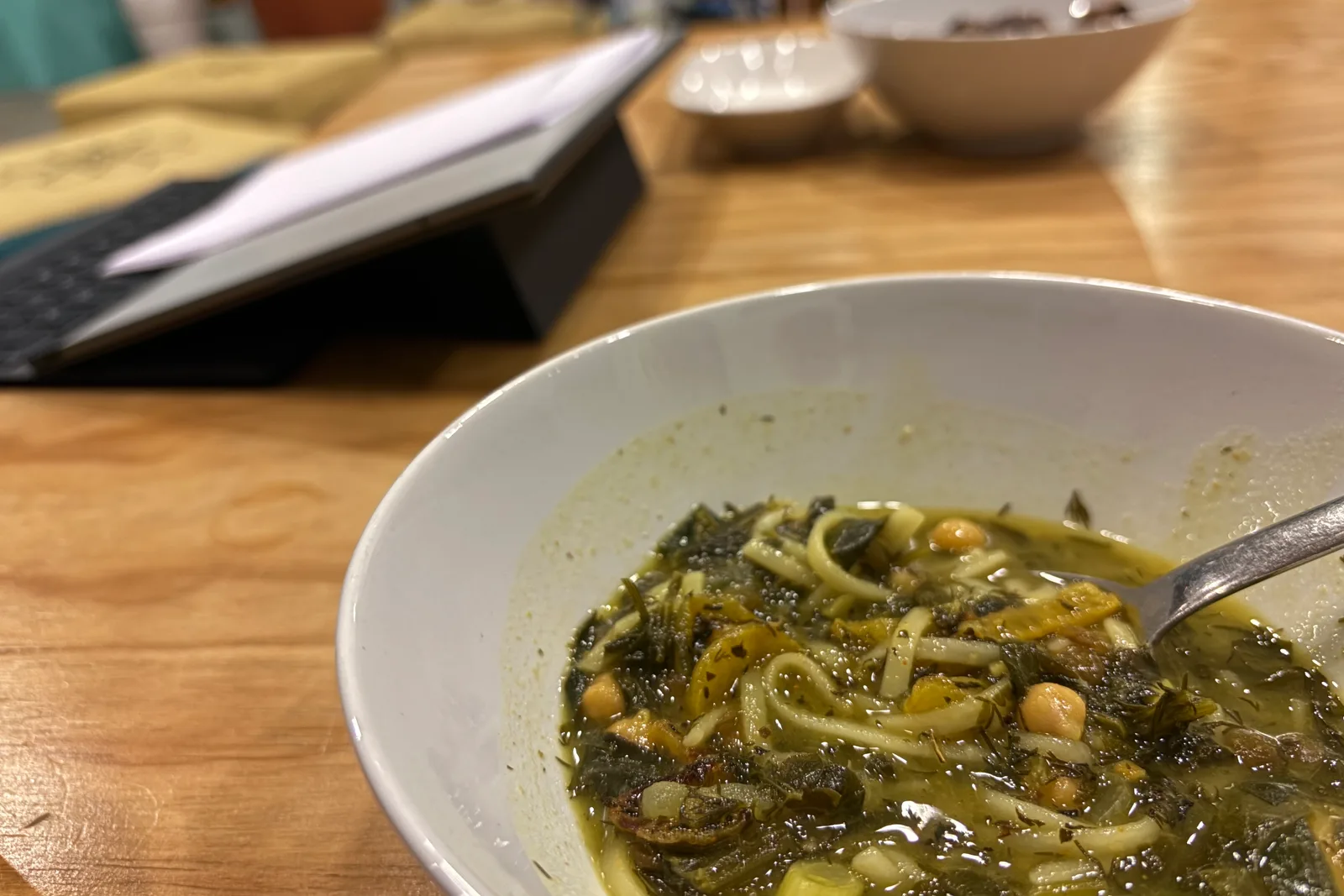
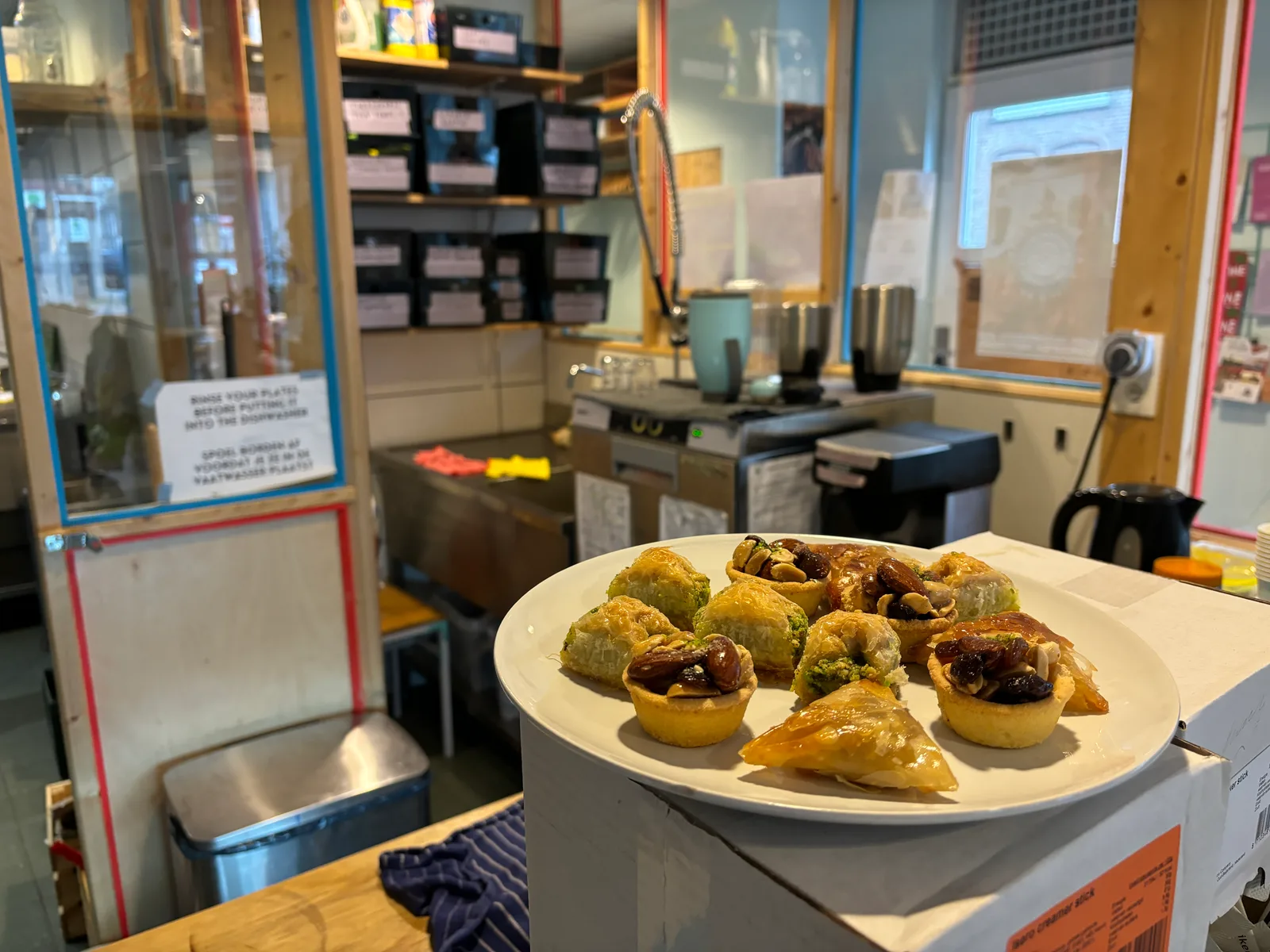
The food I loved most in Utrecht, I ate here: lentil soup thick with mixed spices, hummus (鷹嘴豆泥) that was almost unreasonably good, walnut cake baked by someone’s own hands. A loose gathering of people around a long table, languages weaving in and out of one another, wandering from topic to topic with no destination in mind. People from different generations and different parts of the world, sharing time together as if they were family.
Another world is possible.
Patrick — why do you keep coming back? I had to answer this question for myself, too.
An exchange semester is also the first time truly living abroad — officially becoming an immigrant, in my own small way. What you face is not just the challenge of using an unfamiliar language; you also have to talk about the things that matter here, engage with the political questions of this place, navigate a social world where no one is obligated to slow down and explain things to you. You are your own only anchor.
I always felt this place had something magical about it. People hold genuine curiosity for one another. They’re willing to slow down, to repeat themselves, to help translate — to make sure no one is left out. Here, all cultures are equal. Everyone’s story is acknowledged, listened to carefully. Every person is treated as a singular human being.
One afternoon, I walked in on a quiet weekend: everyone I saw was someone I already knew. “Hi Patrick” — we greeted each other with handshakes and hugs.
For a moment, I felt I had truly become part of the living room. In a foreign place, I had found a home.
Future
Could something like this grow in Taiwan?
In the weeks before I left, I kept turning this question over.
De Voorkamer was born from the need to help refugees integrate into the city. Beyond that, it has received substantial funding from the EU and the Dutch government — resources that keep the space running and allow for a small paid staff. The Netherlands is also a country with large numbers of incoming residents; immigrants and international students in its cities have real needs for social integration. Not to mention the widespread use of English in the Netherlands — even elderly residents at the roadside can easily participate in activities conducted mainly in English.
And among Dutch cities, Utrecht stands out as one of the most immigrant-dense: more than thirty percent of its residents have an immigrant background. Encountering different cultures and communicating in English is simply everyday life here. Sufficient budget and a strong volunteer base sustain the activity space; most events are free to attend, so no one is priced out.
Building a living room is not so easy.
Back in Taiwan, refugee legislation has long been stalled, and other stopgap measures keep running into obstacles. When newcomers can barely obtain legal residency in the first place, is there even space in society to discuss how they might belong? Or consider the language question: neither English nor Mandarin reaches everyone — how do you ensure that a space truly welcomes all? Add in the disappearance of public funding, and if you have to sell tickets to keep the lights on, do the most vulnerable become even more marginal?
Even sustaining what already exists is its own challenge. With an increasingly far-right government and rising racial tensions in Dutch society, the public funding that supports social integration efforts is no longer guaranteed.
But does difficulty mean we shouldn’t try? In this moment in history, might we need more spaces like this? Refugees and displaced communities from Hong Kong, Myanmar, and elsewhere who have landed in Taiwan; migrant workers who have crossed oceans to be here; international students arriving from afar; and the people who have grown up in Taiwan all along — do any of them have the chance to know one another?
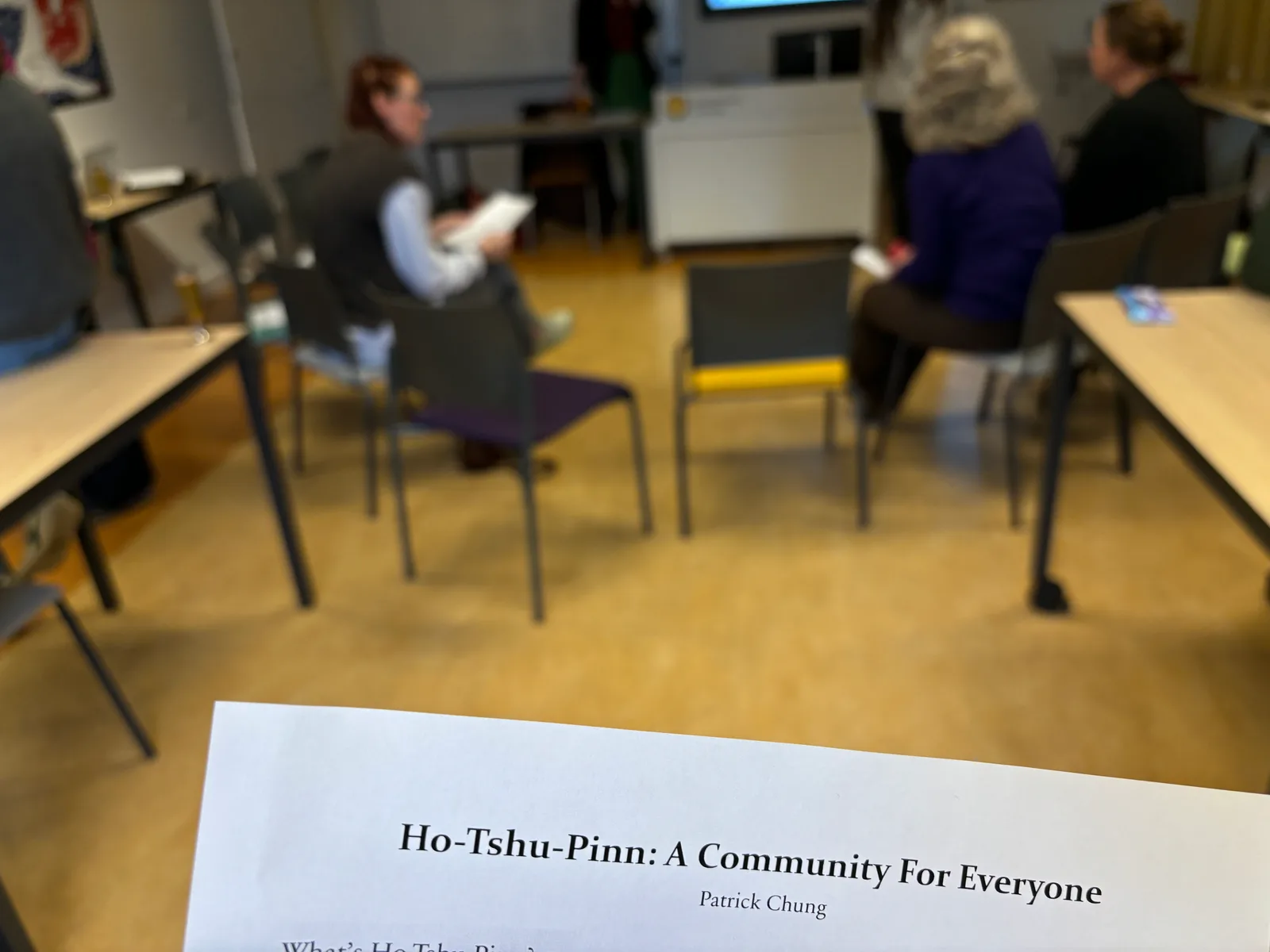
For my final coursework, I submitted a proposal for a Taiwanese living room: mapping out the possibilities, potential partners, budgets and funders, the question of how to build a community, how to invite people in, how to create motivation for members to participate — and then how to decentralize, moving toward a living room built for everyone and by everyone.
Turning it over slowly: no funding or time right now, but maybe, someday, there’s a chance.
That’s what I think.
Departure
On my last day in the Netherlands, I attended a writing workshop.
We had been asked beforehand to bring an object that holds a place in our lives. I brought my own keychain, which reads “I live, I travel” — a souvenir I had made for myself on my first solo trip at fifteen years old.
The host asked us to pass our objects to the person beside us. All you had to do was look at this keepsake and, following your feeling, write down whatever rose to the surface. The one who received my keychain was Olavo, from São Tomé and Príncipe. He wrote a poem called “I Migrate, Therefore I Live.”
When he was young, he worked hard to move from the small island where he was born to Lisbon, where he found satisfying work and met his life partner. Past thirty and dissatisfied with comfort, he had decided a few months ago to leave it all behind and go to the Netherlands with his partner. But it was not what he had imagined — positions were hard to find, and he could only get by in low-wage labor, crushed by high prices and a brutal housing market.
But this was a choice he had made. It was only through continuous movement, he said, that he could keep feeling alive — keep nourishing his life.
It wasn’t so different for me. Coming on exchange was my own choice. The days of moving between cities had slowly shaped me into who I am now.
Just before I left, I ran into a former intern named Mia. When she heard I was about to travel far away, she said she herself would be leaving Utrecht the following month.
“Are you in a hurry?” she asked. Then she tore a page from her sketchbook and handed it to me — an invitation to draw whatever I wanted.
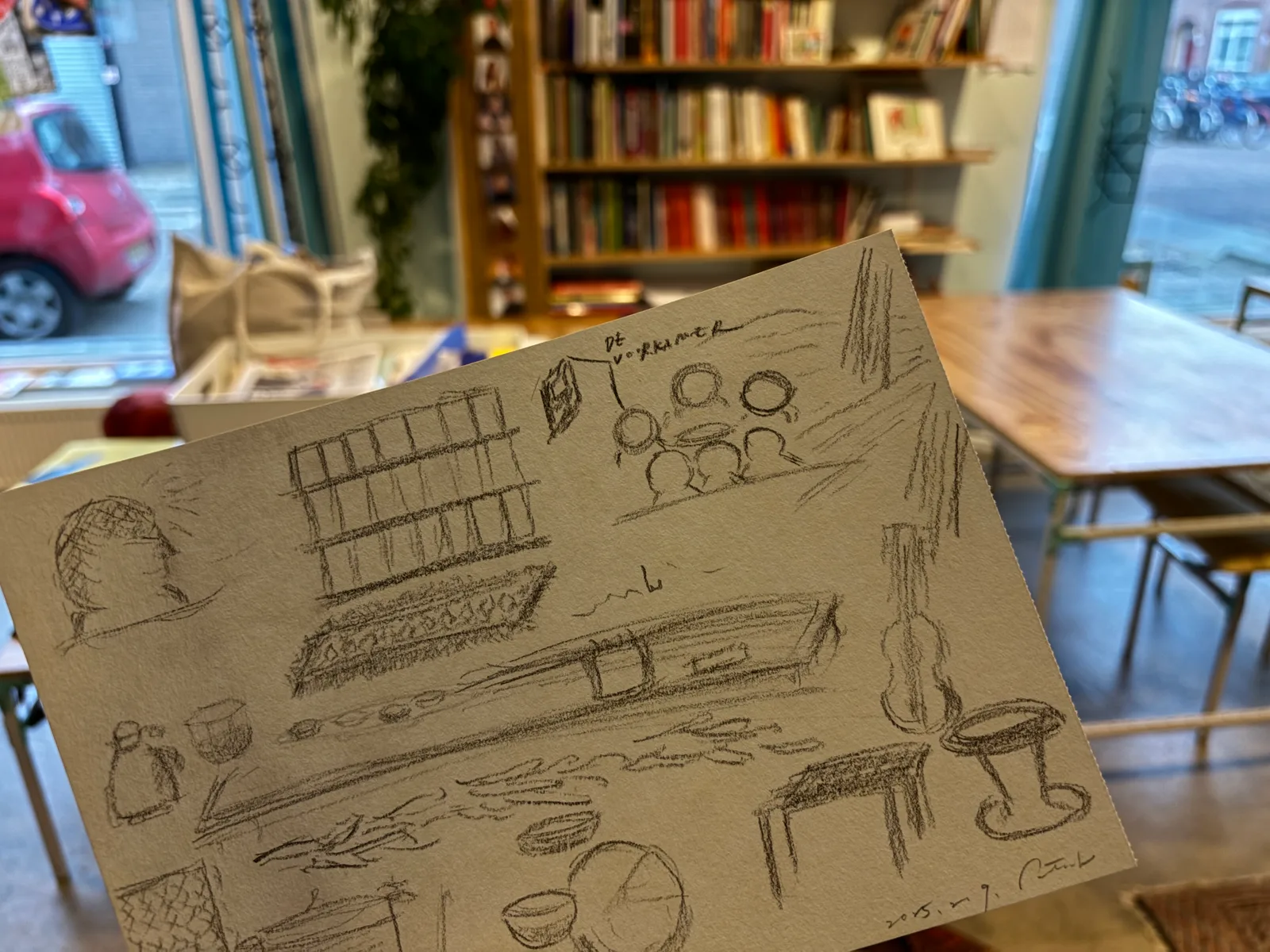
I looked around the living room: instruments scattered near the door, books lined up in rows, a team still in the middle of a meeting, light coming through the window. I drew what I saw. Light and shadow overlapped; arriving and leaving felt, in that moment, like the same instant.
The thought hadn’t finished forming when the door was gently closed. I, too, was someone departing.