Among NTU (National Taiwan University) students who have done exchange programs at Utrecht University, a course called “Coaching & Training” appears again and again in their reflections. The course description is direct: in ten weeks, it guides students step by step into becoming coaches capable of leading teams and running workshops.
As a former design thinking coach (of sorts), I remember the moment a new semester’s timetable appeared — I clicked it open eagerly, combing through the syllabus with delight, curious to see how the Dutch approach facilitation, and how it might compare to what I knew from Taiwan.
Then came the letdown. Looking further down the page: Block 3. Second semester only. With only half a year at Utrecht, I was destined to miss it.
Not long after, I discovered another course: “Train de Trainer: Coaching & Training” — a preparatory course for students training to become facilitators for C&T itself. The concept seemed to be a kind of coaching loop: past students who had taken C&T could return to the classroom as teaching assistants, guiding a new generation of coaches.
This seemed to be my only chance. I sent an email to ask.
A Workshop Without a Theme
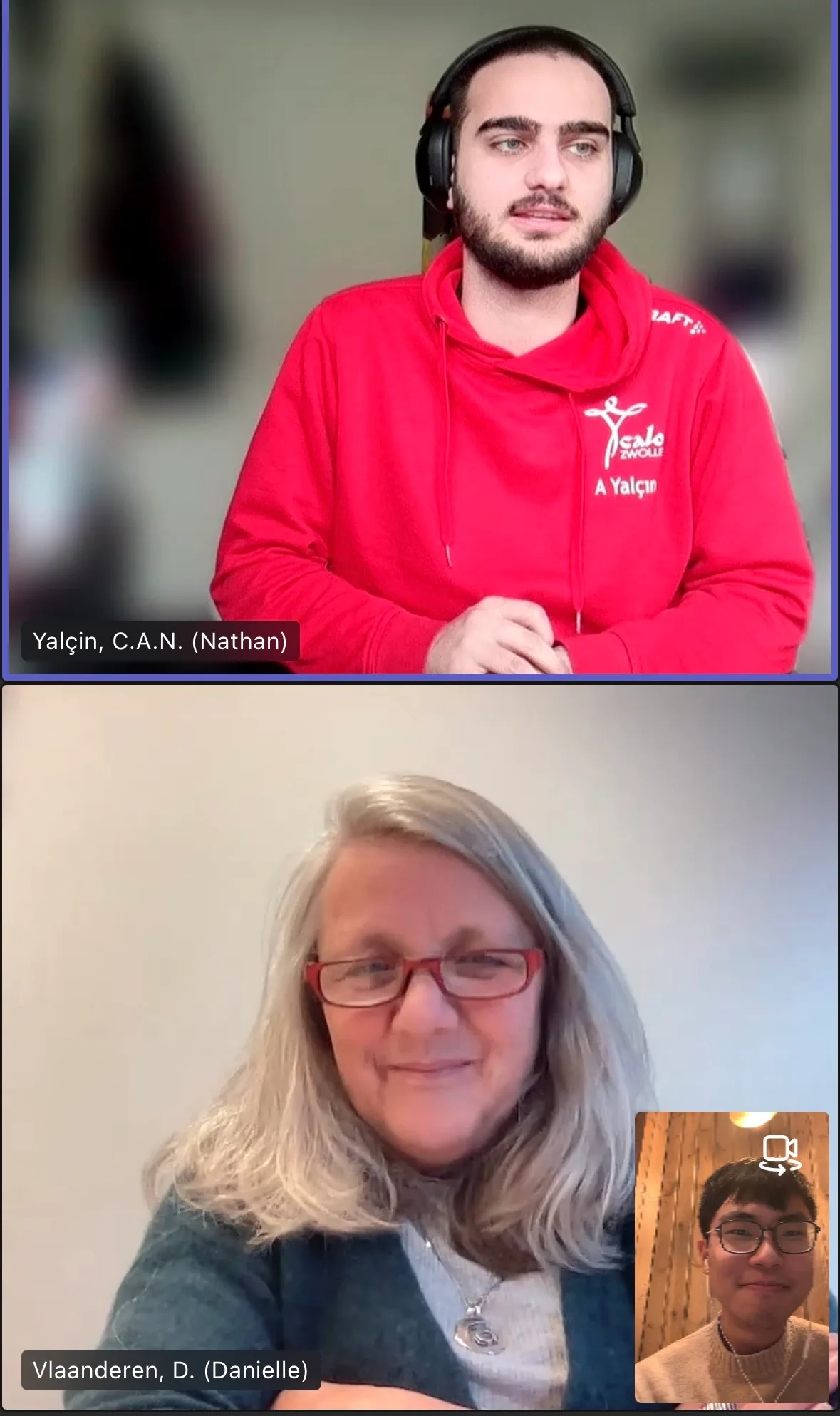
In the video call, it was just me and the course instructor, Danielle. “Of course you’re welcome to take the course,” Danielle said with enthusiasm. But students taking the course were required to lead workshop sessions during the second semester — and if I only joined for the preparatory meetings in the first half, it would be a shame. Facilitation is a craft that needs to be practiced in action; learning the theory without putting it into practice felt incomplete. Maybe, she suggested, I could do something more.
“Why not run a workshop?” It turned out another student was set to graduate early that year and also needed the course credit — maybe the two of us could do it together. Time, location, participants: all open. Choose your own topic. The only requirement was to integrate what we’d learned about facilitation, and treat ourselves as genuine facilitators for the occasion.
I received this call in Istanbul. Sunlight falling across a wooden chair, the whole thing feeling quietly surreal.
As if by design, my partner Nathan was a Dutch-Turkish student in the education program. He introduced himself on our first video call with his square-framed glasses and blue eyes, and told me his story: his family came from İzmir, a city half a day’s drive from Istanbul. His grandparents had crossed the sea to the Netherlands because of war, and each generation had put down roots in the new land. He was born and raised Dutch.
“I should tell you — I’m pretty direct,” he said, adding that he’d often found communication with people from East Asian backgrounds tricky. If you have a need, just say it outright. If I offend you, it’s genuinely not intentional. His manner, his instincts — all unmistakably Dutch.
Getting straight to the point: what did we want to do? As an education student who wanted to become a teacher, Nathan loved inspiring students to grow; he liked the idea of bringing a workshop into a school. I had recently been involved in a community living room project and wanted to explore the theme of migration — to open up some space for conversation.
Talking Politics with Teenagers
“Did you see the news about the Amsterdam demonstrations?” When Nathan and I met again in the Netherlands — at a warm café near the library — he asked me this before I’d even found a seat.
The weekend before our meeting, Israel’s Maccabi Tel Aviv football club had been invited to play in the Netherlands. Sport is politics. In the climate of local pro-Palestinian sentiment, many people couldn’t understand why the government would invite the other side’s representatives onto their soil. The large-scale street marches reflected that frustration. Officials pretended the war had never started, some even seemed to tacitly accept what was happening — making them, in some people’s view, accomplices to the harm.
Tensions had been building before the match. Videos circulated online of Maccabi fans taunting and insulting Arabs. On the day of the game, as fans made their way from the central square toward the stadium, they shouted and jeered continuously. Some tore down Palestinian flags hanging from residents’ homes. The situation ignited: pro-Palestinian protesters targeted Maccabi fans, ambushing them, assaulting them, driving vehicles into them. The city descended into violence and disorder.
In the aftermath, the Dutch government blamed the protesters, framing the Muslim immigrant communities as the ones responsible for the chaos. Nathan’s Turkish identity became part of the target — as if people like him were second-class citizens, objects the government could arbitrarily exclude, despite the fact that he was born and raised here.
“You know, teachers are now afraid to bring this up with students,” he told me. Discussing ethnic issues in the classroom remains sensitive. But we couldn’t understand: something of enormous consequence is happening in society — exactly the kind of thing students most need to know and grapple with — and yet everyone seems to look away. We decided we wanted to talk about it.
But how? The event itself, the Israeli-Palestinian conflict behind it — it didn’t seem to be only a question of taking sides. The lens through which students today understand these things is shaped by the Dutch government’s framing, by statements from civil society, or by voices coming directly from those involved. The media controls the angle of our understanding.
Thinking of Taiwan, where information warfare has been ongoing for years, where fierce conflicts within polarized social media environments had long since become numbing — Taiwan had developed some collective literacy around disinformation. In the Netherlands, it seemed, this was all just beginning. Students were accustomed to absorbing news from social media: content edited for engagement, optimized for eyeballs. If information is the foundation of discussion, how do messages designed to strip context, stir emotion, and mobilize people — how do they help open a rational conversation?
“Let’s do media literacy,” we decided. We’d start from the ground up.
A Classroom for Everyone
“Why do you think schools can’t have these conversations?” Going deeper, nothing was simple. Teachers worried that taking a political stance would invite criticism. Students were so accustomed to giving the answer the teacher expected that they’d stopped saying what they actually thought. If both parties enter a political discussion already unwilling to commit, already imagining each other’s assumed positions — how do we make sure the conversation actually produces collision and thought?
The classroom itself needed to be reimagined. Power dynamics are an obstacle to genuine discussion. Knowledge doesn’t belong only to the teacher; students have the right to express their own views. Perhaps we needed to reconsider the teacher’s role: beyond transmitting knowledge and providing correct answers, could they guide students to articulate their own perspectives? Could they help when students were curious?
Or, stepping back further: in the traditional classroom, the teacher alone decides their role. A conservative teacher who wants to establish authority, delivering knowledge top-down — students can do nothing about it. Conversely, if a teacher decides to flip the classroom and tries to dissolve the power boundary between teacher and student, is that approach genuinely what students want? Or simply the teacher imposing their own vision? Is it possible to let students decide what the teacher’s role in the classroom should be?
“Maybe you could try contracting,” Danielle offered when she heard our dilemma. You could draft a classroom agreement together with the students — asking them to think about what they want from their teacher, what they themselves are willing to contribute, genuinely returning power to the students. Write a contract that belongs to everyone. Let the classroom come closer to what all participants actually imagine.
Nathan observed that Dutch students love freedom and resist constraint. When inviting them into contracting, he suggested framing it not as a set of rules to be obeyed, but as something like: if we want to make this classroom better, we need to sign this agreement together — so that everyone can feel safe and speak freely. Active transformation rather than passive compliance.
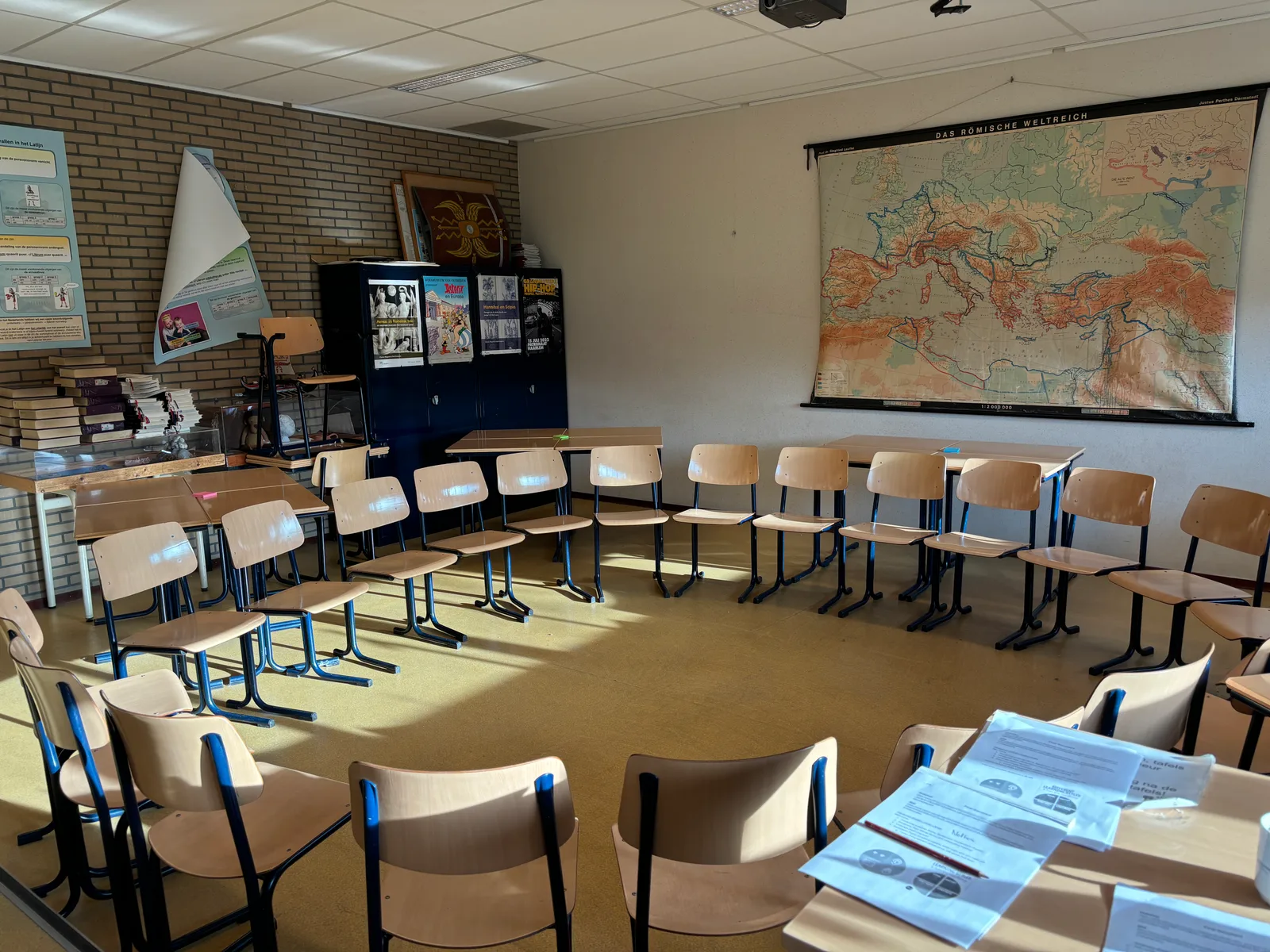
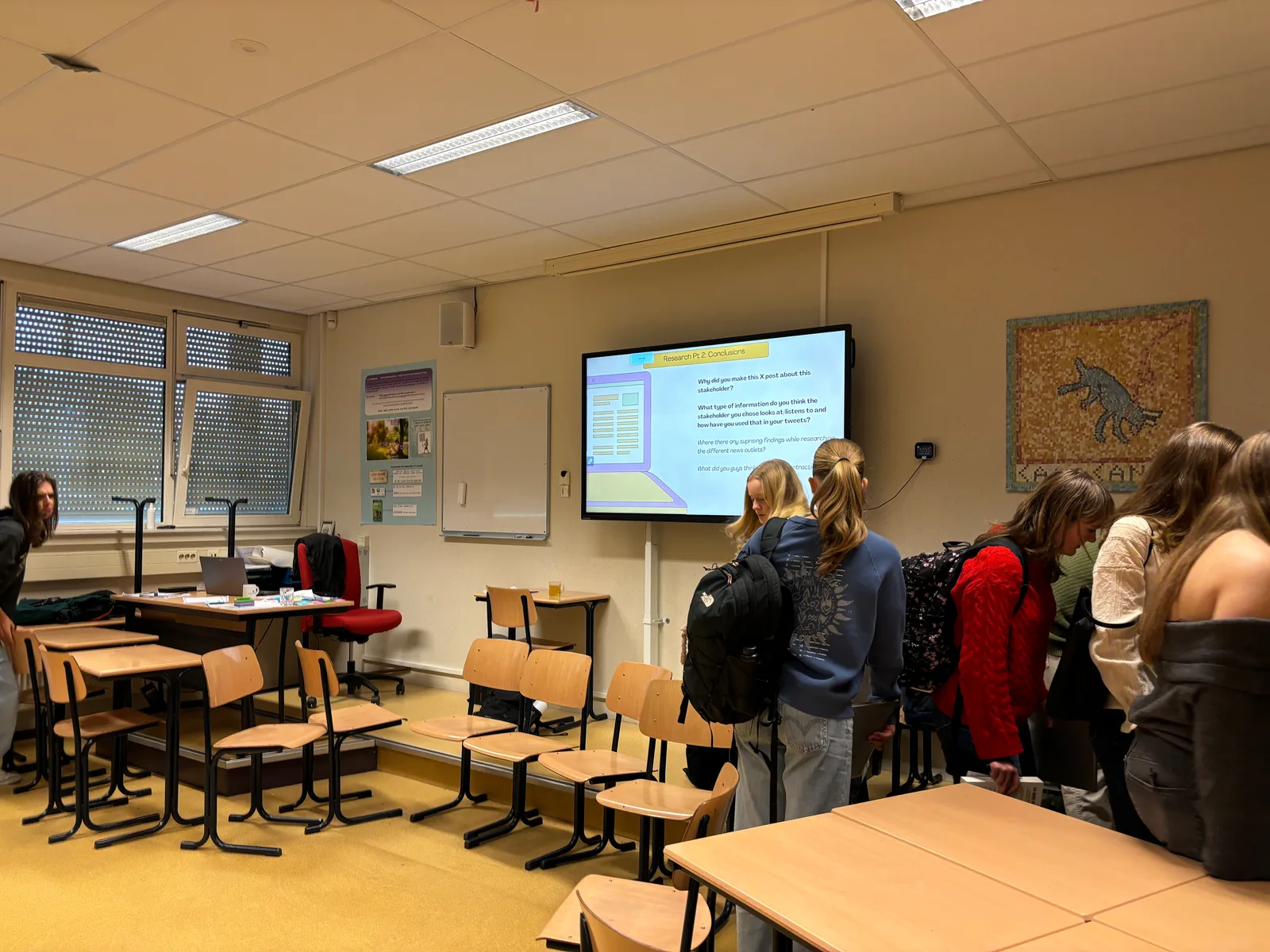
Space is power. We also tried in various ways to dissolve the existing power structures of the classroom. Deliberately staying off the raised platform, breaking into small groups with rearranged seating, chairs arranged in a circle — “so that students feel different the moment they walk in.” Throughout the session, worksheets prompted students to discuss among themselves, with clear instructions guiding their thinking and inviting them to write down their views. If they didn’t want the teacher to intervene, we needed to make sure all activities could proceed on their own terms.
Nathan had been a rebellious student himself. He told me he’d often failed to understand his teachers’ perspectives, hated the rigid uniformity of the curriculum, resented that learning could only follow the direction the teacher wanted. Conflict was the norm; skipping class was his tool against the educational system. He was the most unpredictable thorn in his teachers’ sides. He knew intimately how students chafe against rote instruction — and he was determined that we would not become the kind of teachers he’d once resented.
Since we had the chance to enter a school, could we become a kind of bridge — connecting different ways of thinking, allowing every participant to speak through dialogic teaching? Not issuing command after command, but letting students complete tasks on their own terms. Within layer upon layer of institutional structure, could we carve out a space — return agency to the students — and let conversation happen?
The Workshop
We left Utrecht at seven in the morning. A winter dawn not yet light: tram, train, regional rail, bus — crossing grasslands and canals, turning into a small town. Through the windows of the houses lining the road, people sat with newspapers and coffee, a quietly pleasant Monday morning.
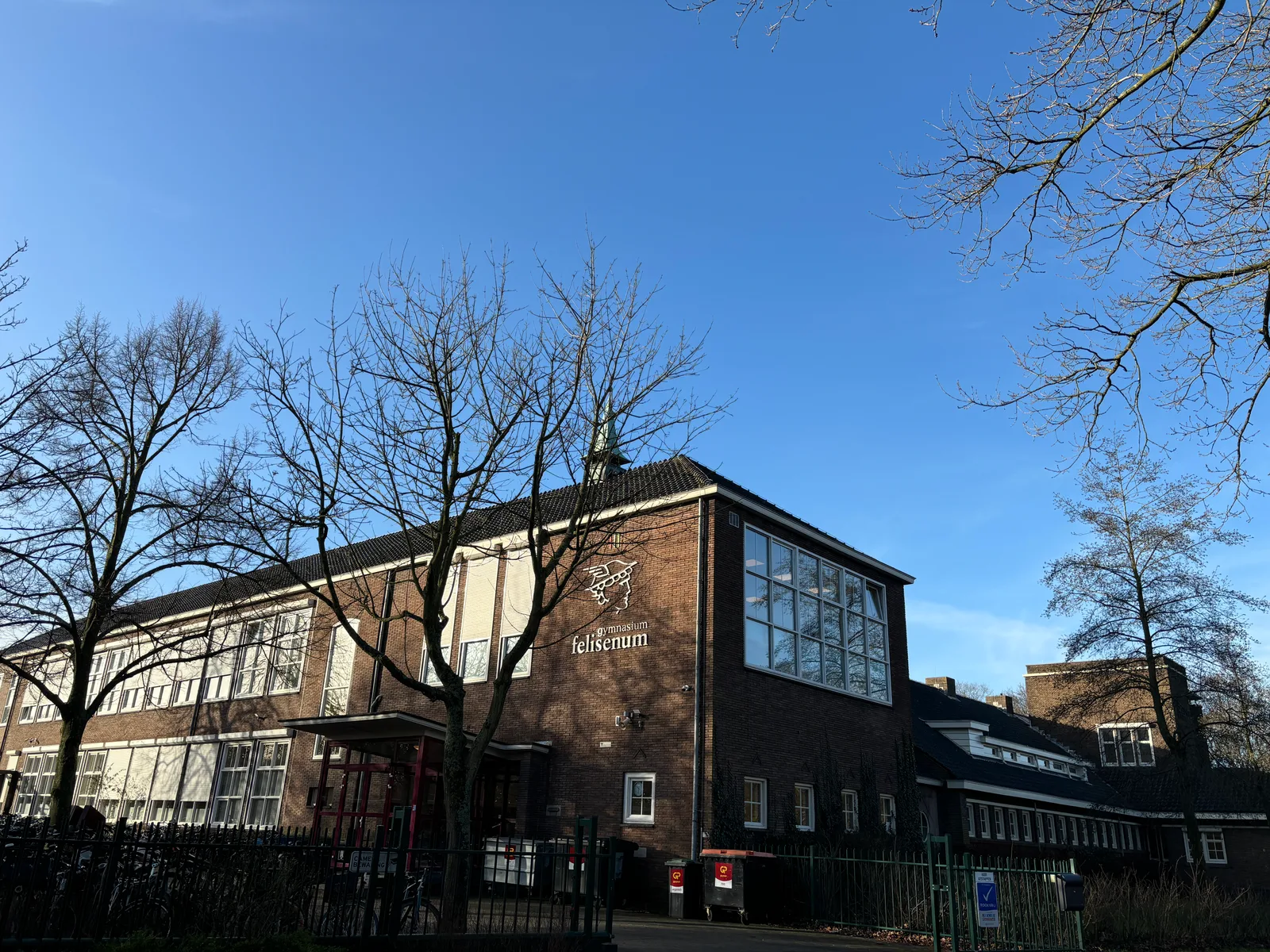
We arrived at Nathan’s former secondary school, Gymnasium Felisenum. The Latin teacher gave us two class periods for the workshop. The Netherlands has its own school tracking system: at twelve years old, teachers can determine whether a student goes into the academic or vocational track. Gymnasium is for the top tier — ancient Greek and Latin are compulsory for humanities students. The room was full of teenagers from middle-class and above families, children expected one day to attend the country’s finest universities.
“Are you nervous?” Nathan asked before we began. I was, a little — it was my first time running a workshop in English.
“A water polo coach I really admired once told me: nervousness and excitement are the same thing. When you feel nervous, it actually means you’re ready to face the challenge.” Nathan had been on the school’s water polo team for over a decade, one of the most promising goalkeepers in the school’s history, who had once considered going professional — “it’s still very demanding,” he’d concluded — and ultimately decided to keep it as a passion.
The students filed in one by one, and the workshop officially began. They seemed to have dropped into a zone of weightlessness — all the usual classroom rules suddenly dissolved, and they had to reorient themselves to how this session worked, to understand what their role was.
Two hours moved like a flowing canal — a lot seemed to happen, and yet it’s hard to recall in detail. I watched students each put forward their views, take turns walking up to sign their names on the classroom agreement they had drawn up themselves. One student said she rarely followed the news, and it was only through this activity that she learned the Netherlands had a large refugee camp called Ter Apel, and that media could be divided into left-leaning and right-leaning outlets. One of the teachers shared how, when they were younger, they had believed the progressive worldview was the only truth — and only after venturing into other perspectives did they come to understand how the other side’s position was constructed. Something, it seemed, had genuinely opened.
Sticky notes covered in handwriting, worksheets with no blank space left, chairs and desks arranged like a small archipelago, a cup of tea left half-finished before departure. By the time I came back to myself, I was already on the bus, swaying with the carriage, drifting toward sleep.
Podcast
In the final days of my time in Utrecht, I visited Nathan’s grandmother’s house. After the workshop, we found a time to sit together and record our reflections on the whole experience.
The weather was good that day. Warm sunlight turned the interior golden. We each settled into an antique armchair and pressed record.
“Their baseline knowledge was less than we expected,” Nathan said. In the workshop, we’d found that most students knew very little about immigration issues and were barely familiar with recent immigration policy — reading a news article required them to pause and search for unfamiliar terms. And yet, paradoxically, immigration had become one of the most fraught social issues in the Netherlands in recent years. What was it that had so thoroughly disconnected the classroom from society? We both wondered whether it was partly our outsider status — as a Taiwanese and a Dutch-Turkish person — that gave us an opening to talk about it at all.
Language was inevitably a barrier. Because I don’t speak Dutch, the workshop had to be conducted entirely in English. But this also meant the local students were having to discuss ideas in a second language they didn’t fully command. Some students were reluctant to speak English, or couldn’t fully express what they were thinking — participation in conversation tracked closely with language proficiency. For me, too, there was a parallel: when students pulled up Dutch-language news articles for their group discussions, I couldn’t offer timely feedback; I had to rely on Nathan to dash around and translate in real time.
During the activity, students’ classroom agreements asked us, as facilitators, to serve as helpers who answered questions on request — meaning that unless a student asked, we wouldn’t intervene. Given that latitude, most groups were able to discuss and work through most of the questions on their own without us. “I told you Dutch students are independent!” Nathan said with pride. When students believe they’re capable of accomplishing things on their own — when teachers don’t treat them as blank vessels to be filled — perhaps everything changes. Like that old saying: not filling the vessel with water, but kindling the flame of learning.
When the classroom becomes a laboratory, the teacher must also adapt. The two class periods of our workshop were each led by a different teacher. One was what you might call a classic bystander: she sat on the raised platform at the front, silently observing everything that unfolded below, with very little interaction with the students. The other teacher asked us first about the design principles behind the workshop, then quietly moved through the room — helping students who were struggling to understand Dutch-language news articles. At the end of the session, during the open discussion, this teacher became a participant: sharing her own perspective on media polarization. It sounds simple, but it’s not. She wasn’t holding her ground — she was sharing what she knew, guiding students toward their own conclusions, while also willing to sit within the circle and think alongside them as equals.
“This should become a semester-long course,” we daydreamed, riffing on possibilities. A single session can only change so much. But if it became six to eight weeks — first letting students grow comfortable with the rhythm of a dialogic classroom, then practicing reading news, identifying bias, opening fact-based political discussion, and working together toward solutions — maybe it could go much further than we’d ever imagined. We certainly hadn’t imagined we’d end up where we did.
Grateful for all of it.
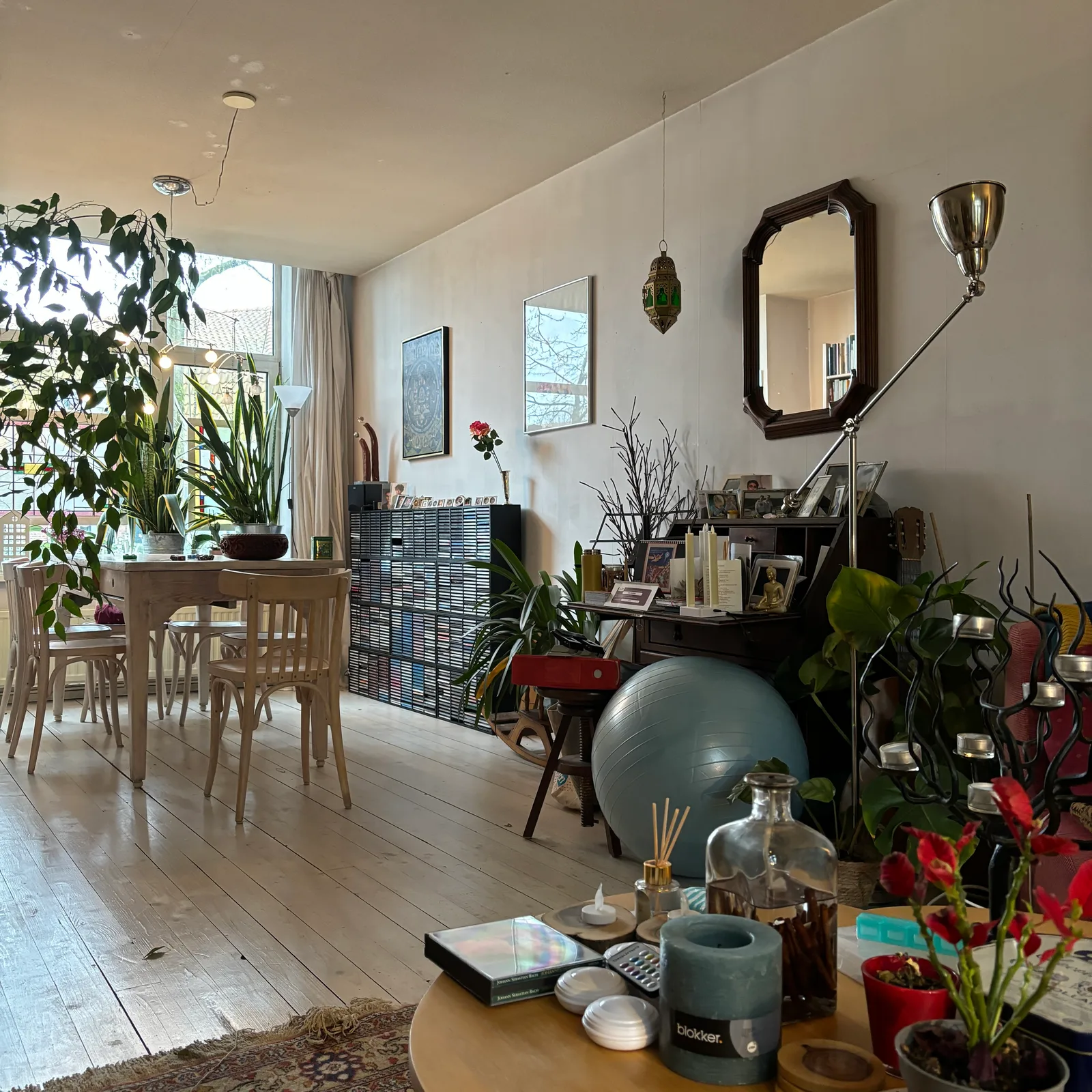
The recorder clicked off. Without noticing, we’d talked for much longer again. Nathan introduced me to the antiques his grandmother had collected: a cabinet of record sleeves, framed photographs the size of a palm, souvenirs from distant countries. “She always loved to accumulate things,” he said — having once fled because of war, she could no longer bear to lose anything more. And there, unexpectedly, we had arrived back at the beginning of the story.
We packaged the audio and sent it to Danielle. Her reply came soon after: “I really enjoyed your podcast — even through a screen, I could feel your enthusiasm. This was truly a wonderful experiment — a completely new way of working for both students and teachers. I’m glad you could see your own contribution to the workshop, and I’m very curious to know: when Patrick gets back to Taiwan, how will he share this experience with his friends?”
It’s been barely four months, and the memory has already grown more distant than I expected. In the end, this is all that remains.