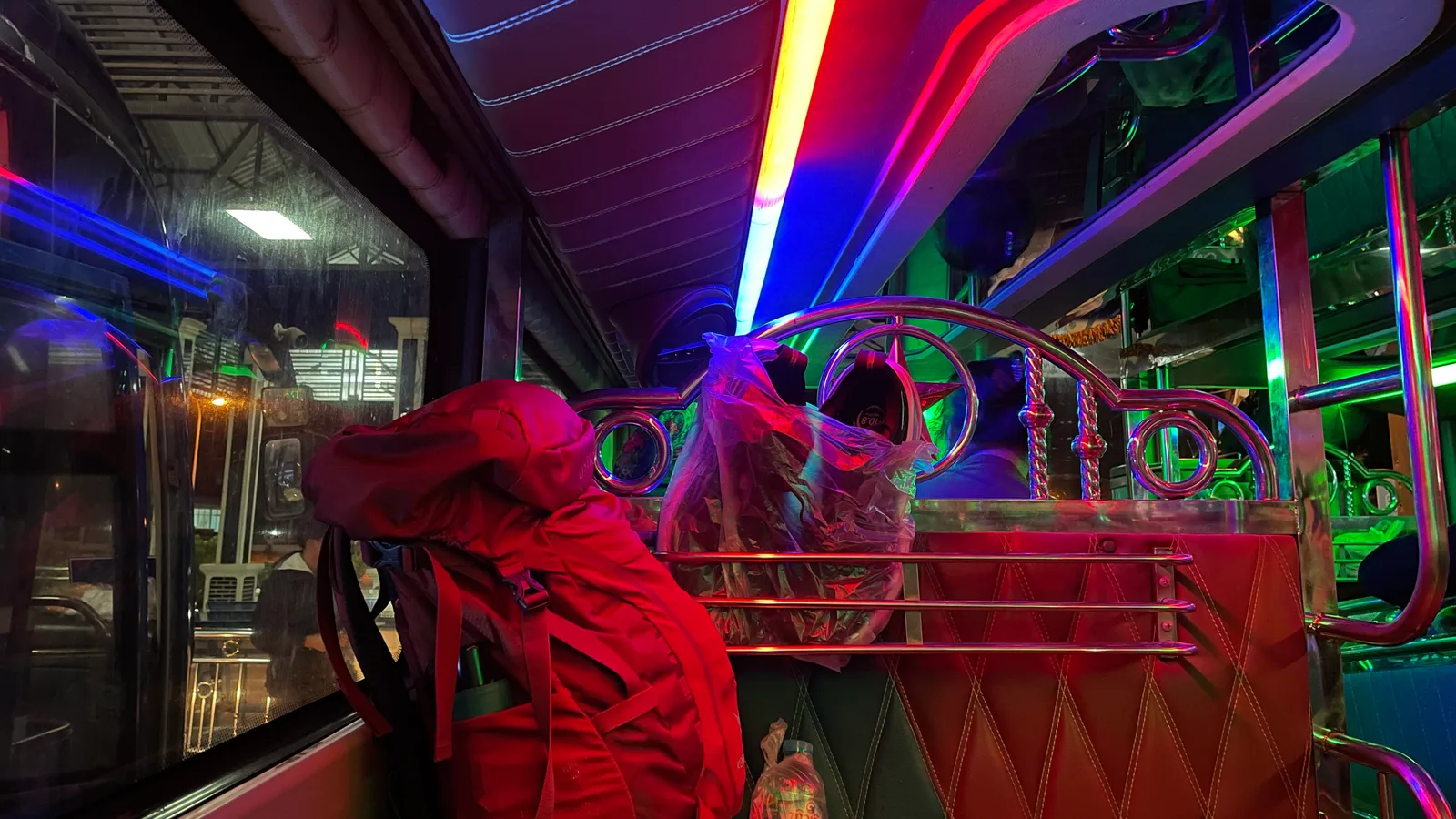
Day X
I was just trying to figure out how to get from Hanoi to Luang Prabang. Flights were too expensive; I’d found a direct overnight bus from Hanoi to Luang Prabang, but it would mean more than twenty-five consecutive hours on the road — too hardcore.
Searching for alternatives, I came across a less-traveled route: a path from Vinh (榮市) to Luang Prabang. It ran west along Highway 7 all the way to the Nam Khan border crossing between Vietnam and Laos, then climbed over several mountain ranges to reach the destination. The midpoint on this route was Phonsavan.
What’s in Phonsavan? A UNESCO World Heritage Site. One of the world’s four great megalithic jar sites. The Plain of Jars. And a great many, many unexploded bombs. I couldn’t believe such a place existed — and quietly added the town to my saved maps.
The Overloaded Minibus
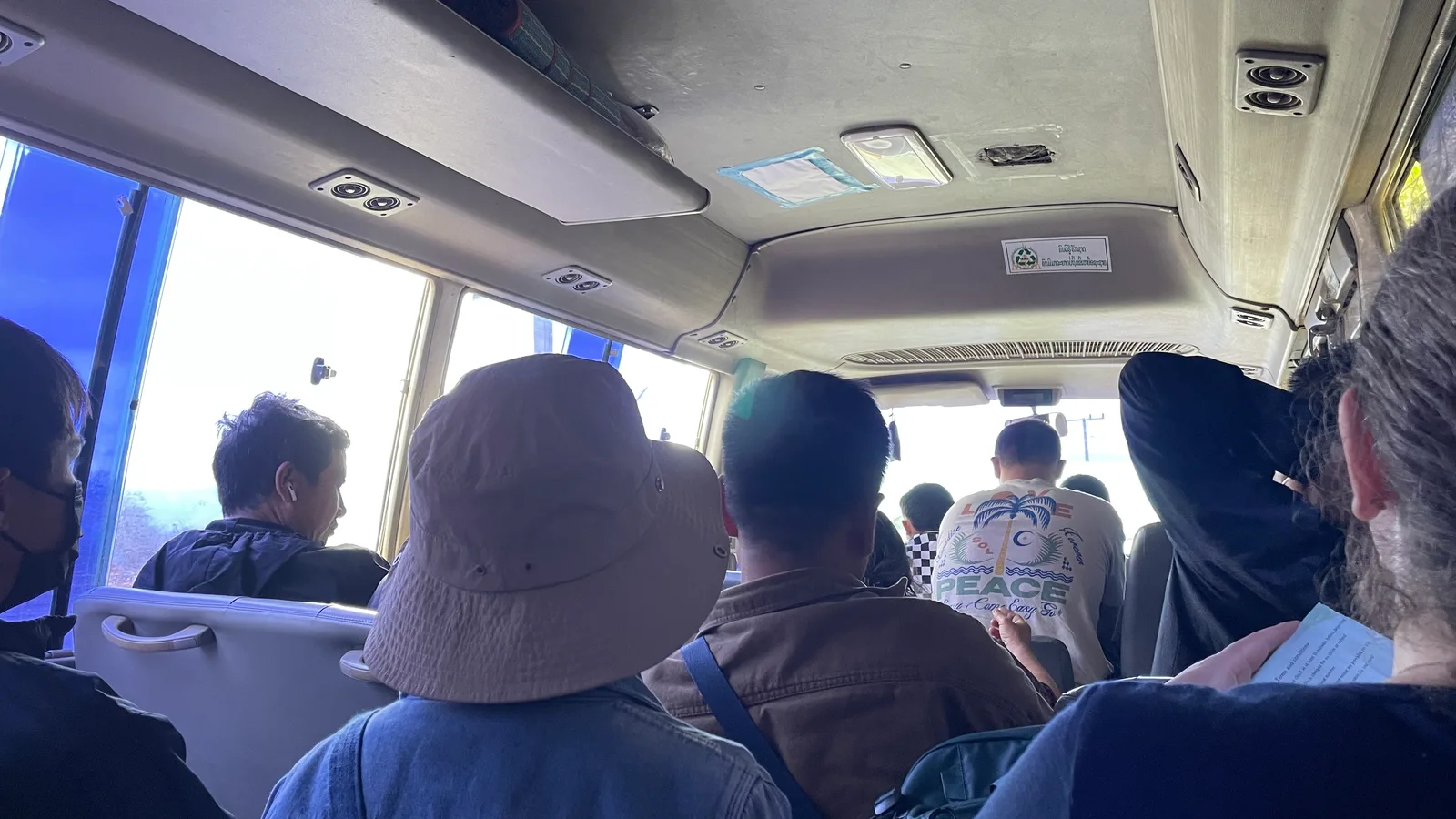
The overloaded minibus rocked and lurched along the mountain roads. It was certainly over capacity — a vehicle that seated perhaps fifteen people was carrying double that. Inside, the air was stale and smelled of earth; the engine burst into furious revving sounds; on any incline steep enough, you could feel the horsepower being wrung to nearly nothing.
The road through the mountains was bad in ways that are hard to describe. Paved surfaces had been ground and scraped day after day by heavy trucks until they barely qualified as road anymore. The whole journey was a series of bone-jarring potholes — craters occasionally appeared in the asphalt, but apparently there was no budget left to repave. Making it worse, it had rained the day before: the water had washed away the gravel patches, leaving conditions even more treacherous.
The movement was motion trapped. In the front seat, a Chinese laborer was enthusiastically showing his family photos to everyone nearby. A white couple by the window watched Netflix. The Lao passenger beside me sat quietly, as if none of this was worth any particular comment.
Sure enough, the engine soon died. The bus stopped at the edge of a mountain valley; passengers filed out. All around us, mountains and valleys stretched without end. Cool air filled my lungs and told me the altitude was rising.
“Everything happens for a reason,” I told myself. Only by stopping do you get to see new landscapes.
But things deteriorated. The bus broke down again shortly after we set off, then again — overheating engine, driver needing a rest, then another breakdown. Each stop lasted nearly half an hour. The only other vehicles on this road were gravel trucks and cargo trucks; not a single rescue vehicle appeared. We had nowhere to go.
A seven-hour journey took thirteen hours. The last breakdown was on a mountain road at night, no light source other than the headlights. This time a flat tire — the driver produced a jack with complete calm. Then the passenger next to me suddenly pointed up and exclaimed. There were so many stars — thousands and thousands, like a Milky Way draped over us. We all looked up together.

The Campfire
The guesthouse had a rating on the booking site that was almost suspiciously high — not a single questionable review. And the price was equally unreasonable: twelve US dollars for a private en-suite double room. But that wasn’t the main reason I chose it. What convinced me was the private Plain of Jars tour the owner offered to guests.
“Welcome to Phonsavan!” It was nearly midnight when we arrived. The moment the tuk-tuk rolled through the gate, there was Kong, smiling to greet us. He said we were the last group of guests. The previous day, it had rained across all of northern Laos, washing out the dirt roads and delaying every bus heading to Phonsavan — the group before us had arrived only an hour earlier.
After a quick wash, I wasn’t ready for the day to be over. I went to the common room to find someone to talk to.
“Are you Taiwanese?”
Wang was the first Taiwanese traveler I’d met on this trip. Hearing that a Taiwanese person had checked in, she’d come straight over the moment she saw my face. Two other guests were Norwegian: one of them, Sig, was doing an exchange at Chang Gung University (長庚大學) and had come to Laos with a friend during the winter break.
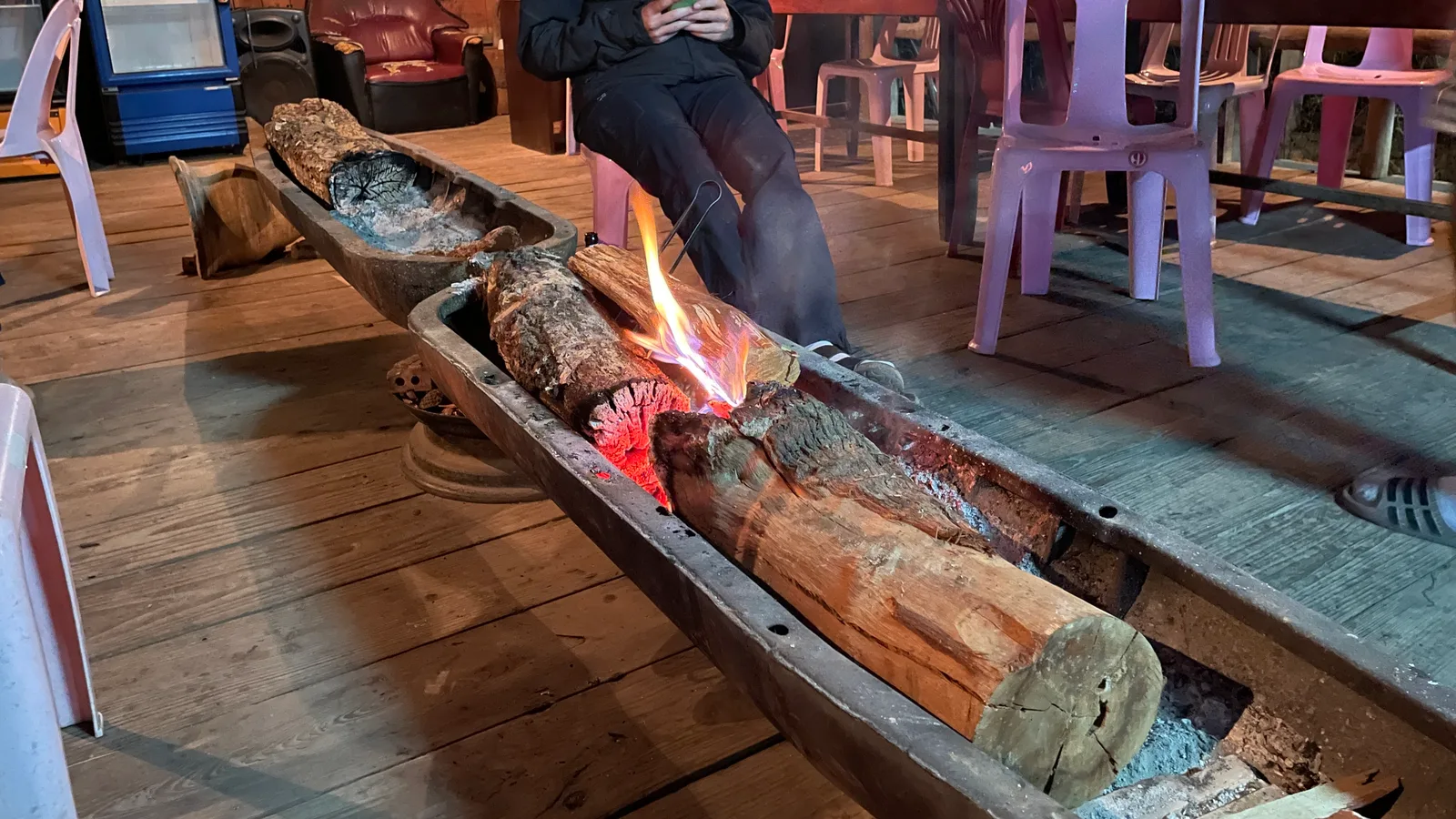
Phonsavan sits in the Xiangkhouang Plateau (川壙高原), 1,100 meters above sea level, enclosed by mountain ridges. The temperature drops quickly at night — the kind of cold that requires a down jacket. So without any discussion, everyone grabbed a chair and gathered around the fire pit to talk.
Topics flew back and forth. Wang shared funny stories from working in aviation; Sig described cultural observations from Taiwan. The rest belongs to that moment.
Then a French grandfather arrived. I said excitedly: Je parle un peu français! Without missing a beat, he switched into French mode and launched into passionate conversation. I summoned every bit of French I had ever learned, trying to follow what he was saying.
He told me to look carefully at the fire pit. Its shell was made from bomb casings. The damage caused by unexploded ordnance was horrific, he said — war had destroyed Vietnam, Laos, Cambodia, and Myanmar; many refugees fled to Thailand and were relocated from there to other countries in Europe and the Americas. His trip was intended to travel through all these countries in mainland Southeast Asia and become a witness on the ground.
Chinese, English, and French ricocheted through the conversation at speed. To be a bridge between them gave me a genuine sense of accomplishment. Language really does make the difference — it lets people share so much more.
The campfire must be the origin of all civilization. Because of cold, people gather; conversation happens naturally.
The Secret War
Everyone piled into the seven-seater van and set off. Not long after departure, Kong said that before going to the Plain of Jars, he needed to take us somewhere first — so we could really understand the wounds of this land.
In the 1960s, communist forces were expanding steadily across mainland Southeast Asia. Beyond the Vietnam War, which many people are more familiar with, a secret war was also fought in Laos (寮國).
Why war? Because at the time, the Pathet Lao (寮共, Laotian communist forces) were fighting the Royal Lao Government. Driven by interests and ideology, the United States chose to back the government forces — to counter the growing communist movement. At the same time, the US used the opportunity to establish military bases in Laos to facilitate supplies and military support for the Vietnam front.
Why secret? Because the United Nations had just passed the Geneva Accords declaring Laos internationally neutral through the Security Council. If news of the war got out, it would be a direct contradiction. And so the killing — relentless day and night — was silenced. Over more than a decade, under CIA direction, over two million tons of bombs were mercilessly dropped on this land. Phonsavan, as the Pathet Lao’s main base, received the densest bombardment.
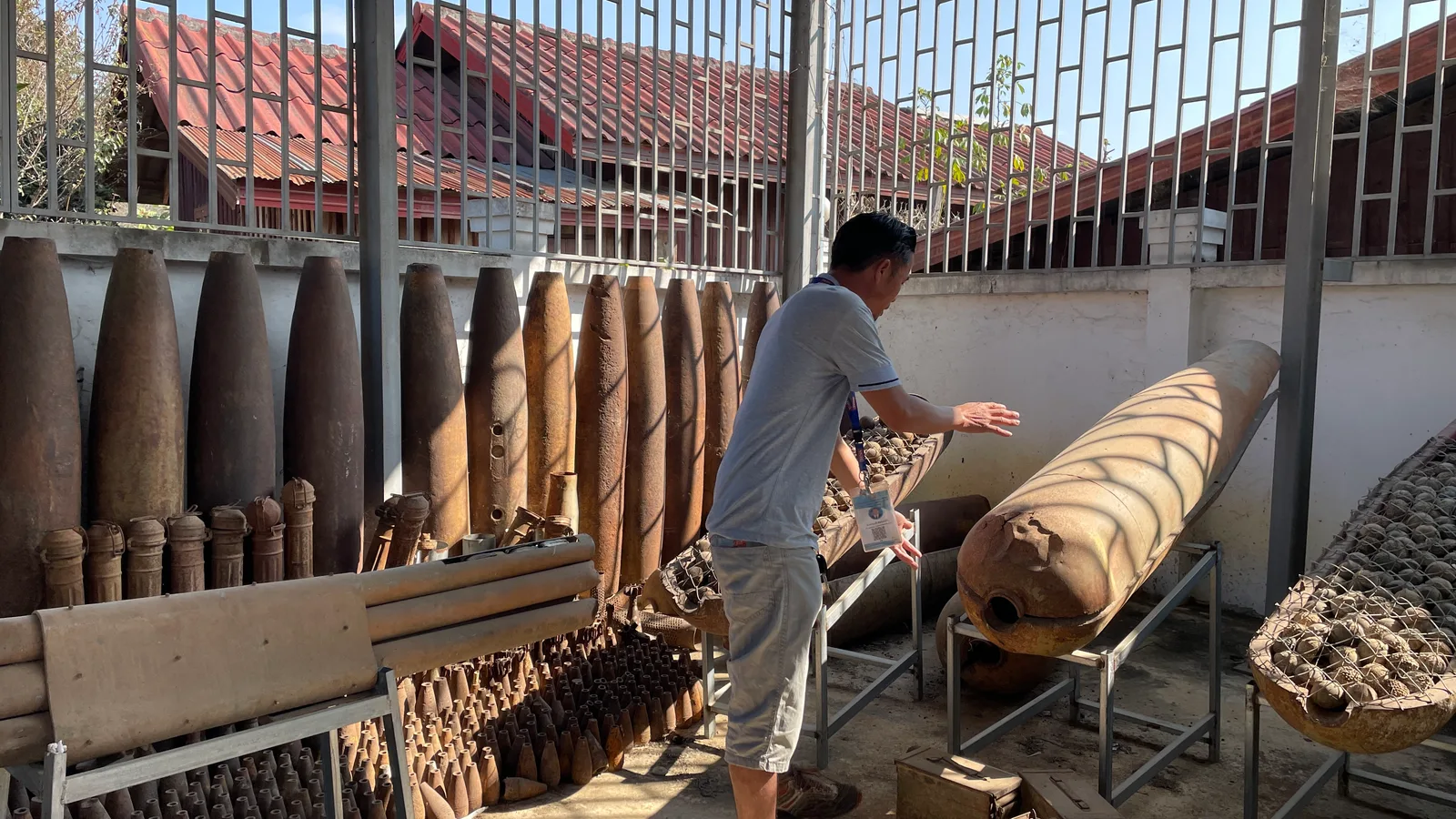
What made it even worse was the type of weapon used: cluster bombs. A cluster bomb is a steel casing containing hundreds or thousands of small spherical bomblets, each roughly the size of a tennis ball. To detonate, one of these submunitions must rotate a certain number of times after release. So the altitude of the drop matters enormously. Too high and they explode in the air; too low and they hit the ground without detonating. The worst case — where the pilot dropped from an altitude that was close to the detonation threshold but not quite — meant bomblets landing in a nearly-armed state, ready to explode at the slightest touch.
Twenty years after the war ended, as Laos gradually opened to the world, the secret war slowly came to light, and international support began trickling in. But for some things, it was too late. Time had buried many of these bombs deep in the soil. Farmers tilling their fields or heating food over fires accidentally triggered explosions and were killed or maimed on the spot. More heartbreaking still: poverty drew people to seek out unexploded bombs for the high value of scrap metal — to live and die with the bomb.
The harm the United States caused didn’t end there. During the war, they needed an army willing to take orders. They first tried to hire Thai soldiers — similar in appearance to the Lao — but the Thais didn’t want to fight. Eventually they found the Hmong (苗族), a people who had migrated from northern to southern Mongolia and then, crossing the Yunnan mountains, eventually arrived in Laos.
The US promised that if victorious, they would help the Hmong establish an autonomous state — half of Laos to be shared with the government forces. Drawn by such a compelling offer, the Hmong agreed to help. More than thirty to forty percent of the ethnic group joined the fighting. But when the war ended, they received none of what they had been promised. They were instead driven from their homes and scattered in all directions.
America came here to create chaos. After extracting what it wanted, it left — leaving the local people to deal with everything it had created.
Kong led us through the exhibit, telling the story as we walked. Outside, the bombs and tanks left over from the war were on display. The end of the war didn’t mean the end of everything; the weapons were simply left on the land. The wound formed a scab over time, but it never went away.
Do Lao people hate American tourists? Not really, Kong said — many Americans at the time didn’t even know what was happening here. What he doesn’t like is the president who authorized it all. He is grateful to every American visitor who comes to Phonsavan and chooses to understand.
And did anyone learn a lesson? Kong said the US recently shipped large quantities of cluster bombs to Ukraine to bomb Russian forces occupying the border. He said it was hard to imagine what would happen after that war ended.
Site 1
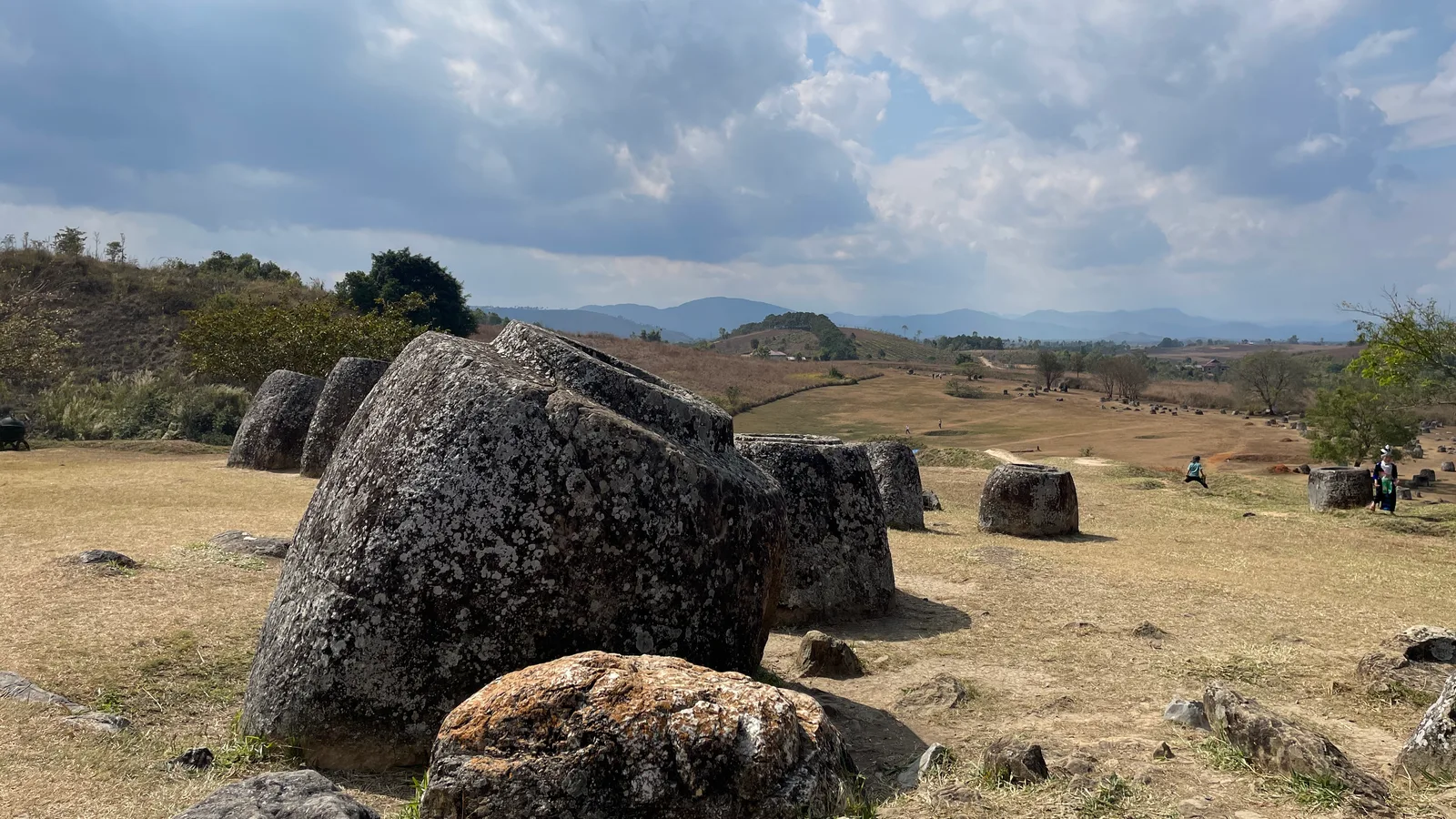
The Plain of Jars is considered one of the four great megalithic jar sites in the world. In and around Phonsavan there are more than sixty sites, numbered in sequence, each scattered with stone jars of varying sizes. Only a few are open to visitors, and Site 1 is the largest and most famous.
To this day, archaeologists still don’t know the true purpose of the jars — only that they may be connected to funerary rituals. The mystery adds another layer to the story.
The jars aren’t unique to Laos — similar ones have been found in northern India and Sulawesi. Kong thinks the Indian ones are the oldest, because their shapes are simpler than those elsewhere — most likely the original version. A Chinese couple said they had been to Sulawesi, where there are many interesting burial traditions — for example, the practice of secondary burial: the body is first left to decompose in the earth, and after some time the bones are dug up, dressed in new clothes, and buried again. Sig mentioned that Norway also has unusual burial traditions: tribal chiefs were placed on boats with weapons and other goods, in the hope they could use them in the next life. Then the boat was either buried in the earth or set ablaze at sea.
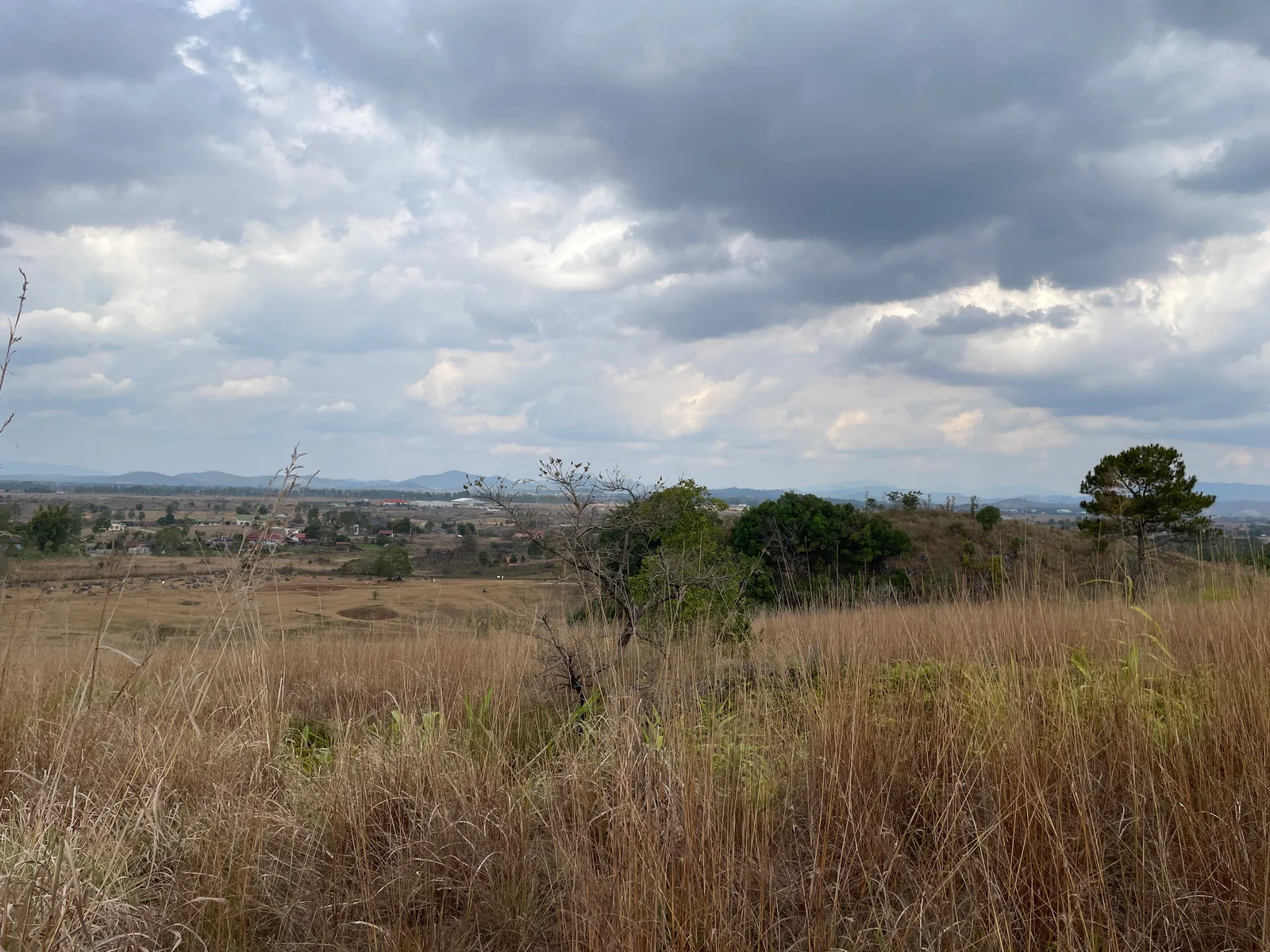
The site is a vast plain, with hundreds of stone jars scattered at random.
Archaeologists have spent much time trying to identify the jars’ function. Around some jars, they’ve excavated groups of human remains and what appear to be burial goods, leading to the theory that each jar may represent a family. They believe the residents placed the deceased inside the jar first, waited for decomposition, and then performed a secondary burial around the jar.
But Kong doesn’t buy it. If someone was dying, would their family really have time to find stone, transport it, and carve a jar? It would take forever. No one’s family would wait that long — holding on until the jar was finished before allowing themselves to die. His own theory: the jars were used to hold offerings and commemorative objects, with no burial function. The answer remains elusive.
It wasn’t only jars on the plain. There were also enormous craters. During the Secret War, the plain was a battlefield; soldiers dug trenches and used the jars as cover. The bombs blew craters several meters deep into the earth.
But the land has a capacity to heal itself. Over the years, water and nutrients accumulated at the bottoms of the craters, and beautiful trees grew out of them.
Site 3
To reach Site 3, you pass through a dry field.
Along both sides of the path are iron stakes marked MAG. Before 2017, because this area had not been fully demined, visitors had to walk between the stakes to ensure their safety.
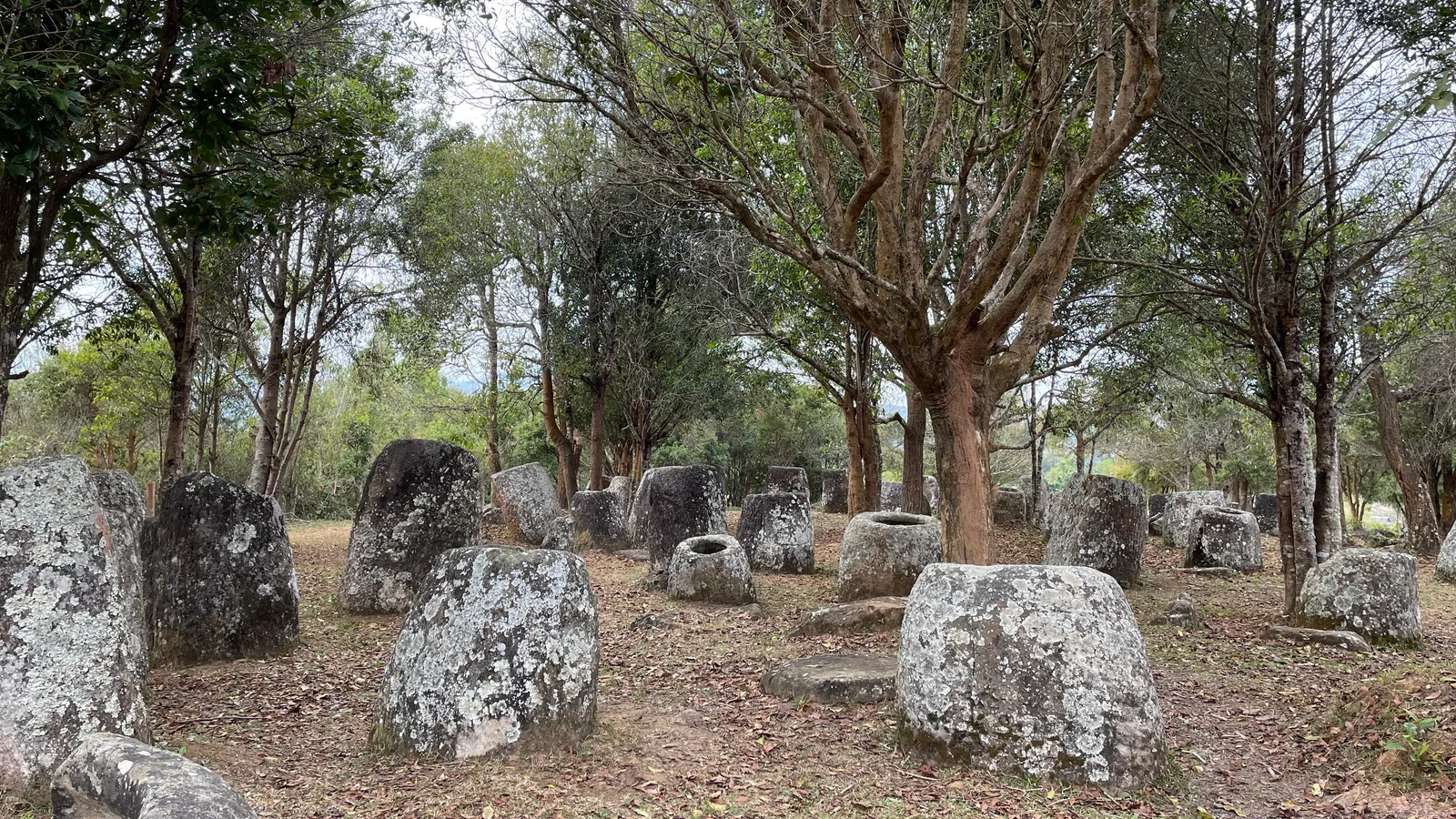
The jars here are denser, and more varied in shape. Kong explained that these jars are made of sandstone — easier to carve, and the material was more readily available.
Site 2
Site 2 is in a forest. The jar designs here are the most refined; some have lids, and the shapes aren’t simply cylindrical. Wang said one looked exactly like a canelé (可麗露, a French pastry with fluted sides).
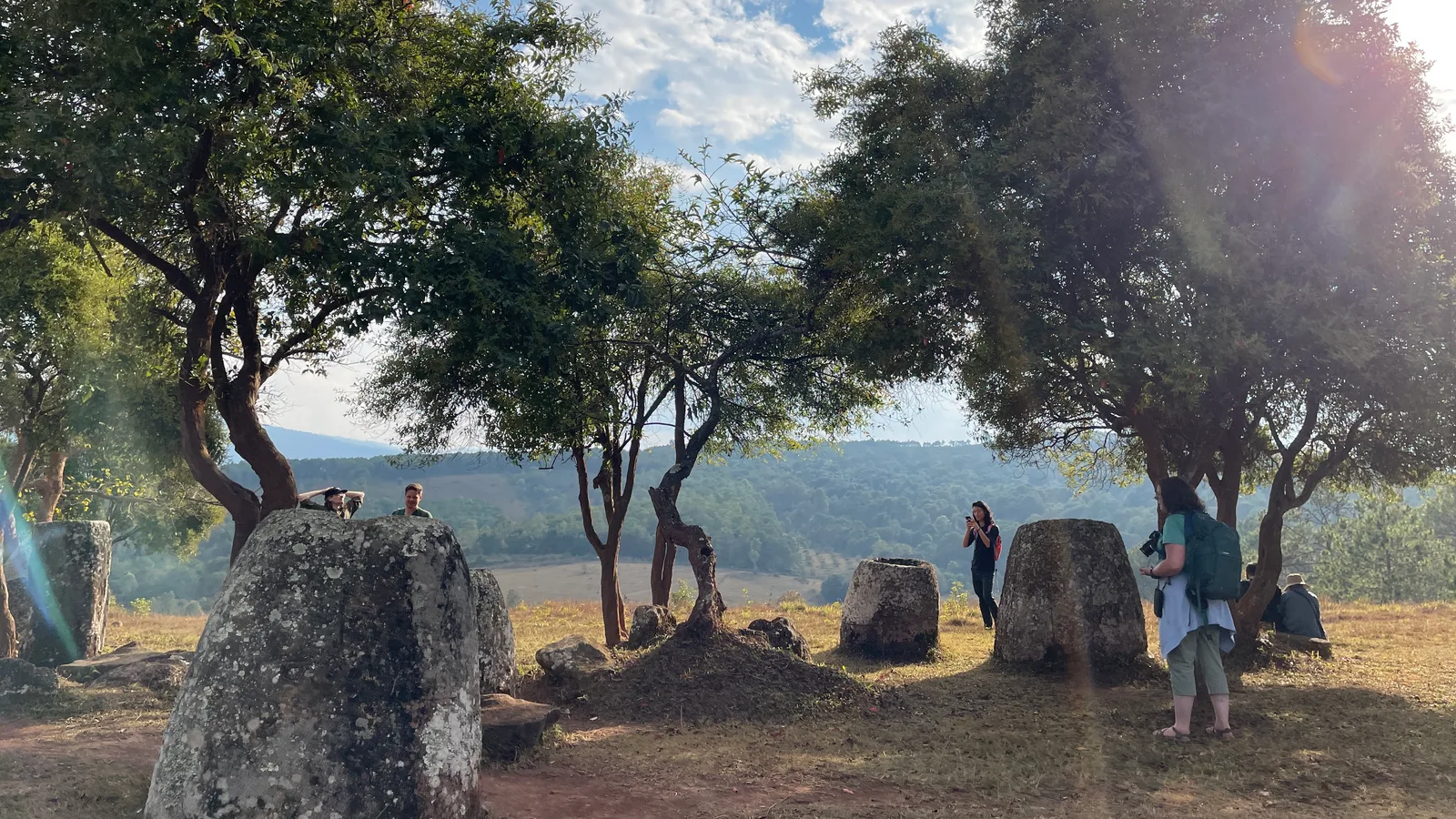
The second section of the site is on a small hill. The moment we climbed up, the clouds parted and sunlight poured down. Egg-yolk yellow light over blue sky, green grass, and the stone jars — plus a scattering of stone discs across the ground. It was beautiful. Like arriving at the edge of the world.
At the end of the tour, Kong asked everyone: after a full day, why do you think the jars exist? Sig thought they were for storing whiskey; I thought they were for burying the dead. Everyone had a different answer.
Kong offered one more theory. He asked: why did we all come to Phonsavan? For the jars, of course. Maybe that was exactly the point — that some ancient dynasty deliberately left these jars behind, so that future generations from all over the world would make the journey to Phonsavan to admire the greatness of whoever created them.
And perhaps that’s right. People always leave in the end. Only the jars persist across generations, letting the voice of one age be heard by people far in the future. People have always wanted to prove that they existed.
After the Return
The bus didn’t leave until eight, so I went back to the guesthouse first. With time to spare, I walked to the nearby MAG (Mines Advisory Group) exhibition hall.
MAG is a local NGO that organizes and trains local people to carry out demining operations in the area. Over the past decade or two, they’ve cleared many agricultural fields — with many more waiting.
One exhibit was a pile of scattered dry twigs and leaves. The label read:
“If this were you — could you tell a bomb from the leaves?”
I walked into a roadside restaurant and ordered at random since I couldn’t read the menu. What arrived was an enormous plate of stir-fried noodles — enough for three or four people. Not bad, but far too much; I ate half and gave up. When I went to pay, an old man approached from nearby and tipped everything I hadn’t finished into his own bowl.
I was briefly startled and didn’t know how to respond. Even writing this now, I’m still not sure what I felt.
In the half hour before departure, I sat beside the guesthouse fire. Everyone was on their phones, filling the blank space before we left.
Kong laughed suddenly and pointed out that everyone was on their phones. I wasn’t sure if what he meant was: why isn’t anyone talking?
I asked him where the firewood came from. Kong, poking the logs with tongs, said with a grin: from all of you — it’s your money that pays for the wood. On average, they burn the equivalent of five hundred US dollars’ worth of wood in a year. I had a particular fondness for this fire, privately — because it was a fire, and it was the fire that gathered everyone here.
The bus arrived. Before leaving, I shook hands with Kong and gave him a hug. Thank you for your help — I really meant it. It was because of him that I came to understand this land more deeply. If I have the chance, I’d like to bring more people here someday.