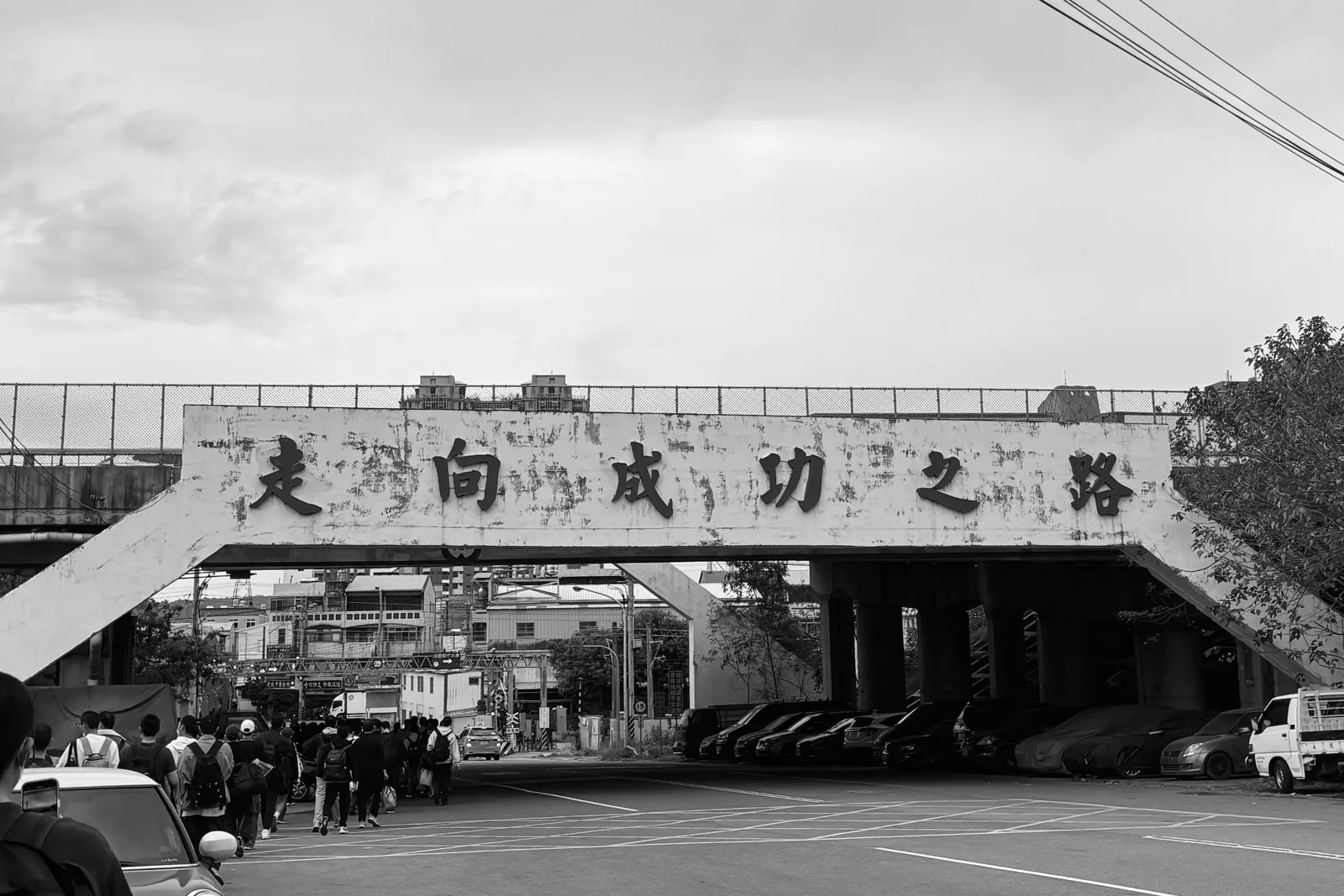
The barracks are a land that permits only obedience. We had barely set foot on the grounds of Chenggungling (成功嶺, Taiwan’s main conscript basic training base) before we were herded like ducks into the Zhongzheng Hall (中正堂).
The vast auditorium stretched endlessly, seating a thousand. Enormous slogans hung from the walls: “Beloved and Sincere” (親愛精誠, the ROC military motto), “Take upon yourself the rise and fall of the nation,” and “Fight for the development of the Republic of China — fight for the safety and welfare of the people of Taiwan, Penghu, Kinmen, and Matsu.”
I only read those slogans clearly later. In that moment, we were just hurrying into the hall, not permitted a single instant’s delay. The squadron leader guided everyone to their seats, expression grave, issuing orders without emotion:
“Everyone undress. Change into examination gowns.”
At that command, hundreds of shaved heads began to move. There in that great, unshielded hall of a thousand, we hastily dropped our bags, squeezed into the narrow gaps between chairs, and shed our clothing layer by layer. Before I had time to think, I was down to only my underwear.
This was my first experience of naked power.
The Power Pyramid
Every conscript who enters the barracks acquires a kind of superpower: you can meet a complete stranger and already know, without asking, exactly how much power he holds.
The clues might be in the clothing. New recruits always wear their battalion relay race fluorescent vests, numbered but unnamed. Senior soldiers wear blue Doraemon-print tracksuits — upon spotting one, you slow your step and check whether your shirt is tucked in. If you encounter someone in full military uniform, you may steal a sideways glance at his left shoulder: is it one bar, two bars, or has a plum blossom bloomed there? (And don’t forget to greet them.)
The clues might also be in space. Every indoor space used by conscripts must have an elevated platform — whether the grand hall, classroom, command stage, or even the canteen. Whoever stands up there issuing orders demands that those below straighten their backs and look upward with deference. Senior soldiers have their own bathrooms, their own dormitories, their own offices — kept locked, entered only with permission. We slept in great open bunks, dozens to a room, no space between us, barred from returning to the dormitory during the day without permission, and visited by senior soldiers making nighttime rounds.
If you were to draw a power pyramid of the barracks, the central commander sits at the apex, followed by the base commander, battalion leader, company leader, platoon leader, squad leader, and finally the duty senior soldier. Where am I in all this? New conscripts rank below caste altogether — untouchables without a varna.
Power is an invisible net, and once inside it, there is no escaping. In the name of respecting superiors — that is, complying with the will of those above — all manner of strange customs arise. Whenever the central commander speaks, the grandest auditorium must be arranged; the moment he takes the stage, every conscript springs to attention and shouts in unison: “Good morning, Commander!” Conscripts marching past the base command office must lower their voices and slow their steps, lest they disturb an officer at work. The moment the battalion leader picks up the canteen microphone, no matter what you’re eating or drinking, you must set your bowl down and listen carefully. You never know which tripwire might set a superior off, which mood might send everyone into chaos. And so those beneath the net tread carefully, extending courtesies far beyond what is required, contriving to never be found wanting.
“You are not allowed to have your own thoughts, your own actions!” a senior soldier once shouted from the platform.
In this vertical, power-explicit organizational experience, everyone clearly understands their own position in the hierarchy. Honestly, I believe there are only three kinds of people in the barracks: those who give orders, those who follow them, and those who must do both — obey superiors while commanding those below. The latter are like middle managers in a corporation: carefully navigating every superior’s tripwire while being held accountable for unpredictable subordinates. No real control, yet endless responsibility.
In concrete terms, what does this look like? If a new recruit’s laundry bag isn’t tied tight enough, or a conscript is caught hiding a phone — the company leader is deemed to have failed in guidance, and the entire unit loses its weekend leave.
Because no one knows exactly where the line is drawn, these middle-ranking officers retreat further and further to avoid crossing it, becoming strict overseers of those below. Some apply the harshest standards to new recruits — resorting to public humiliation and low-volume berating — authoritarian discipline practiced until every man can sit still on command.
No one wants trouble. And if trouble does come, the goal is to make sure it doesn’t touch you. This isn’t only the middle-ranking officers — conscripts begin policing themselves as well. Whatever you do, ask a senior soldier first, make sure someone has endorsed the action before you move, so that any mistake you make isn’t really yours — it was the senior soldier who gave the wrong instruction.
I was assigned to the meal-serving team. One day, we were informed by a senior soldier that from now on, we must have every bowl of food plated and arranged on the tables before the rest of the unit arrived. We did so. That evening, another senior soldier came running: he worried the pre-plated food would go cold and taste bad, and it made more sense for everyone to serve themselves. We hastily adjusted. The next morning, a superior noticed and questioned why we hadn’t pre-served the food to save time. We started over. Whatever a superior says is, by definition, correct.
There are no unified rules in the barracks, and no one knows what the truly correct rules are. Ask ten people, hear a hundred different answers. Whatever the superior says is the only standard. People say the military runs on one order, one action — meaning: if you haven’t heard an order, do not move.
“Military service wastes your life” — this has long since become a cliché. More precisely, people waste enormous amounts of time waiting for orders, or executing orders that don’t matter in the least.
The daily schedule goes like this: wake at five-thirty, dress and fold the blanket; cleaning and breakfast by six-thirty; idle at the classroom by seven-thirty; formal instruction begins at eight-thirty.
“Why can’t we wake up later?” you might ask.
“These are the superior’s orders.” Efficiency is none of your concern — that you have time to sit idle is already a privilege.
The closing ceremony is scheduled for eleven in the morning, with the central commander in attendance — you cannot afford to lose face. And so superiors demand a full rehearsal at ten. The captain, fearing embarrassment before his superiors, summons all thousand conscripts for a rehearsal of the rehearsal at nine. Worried that the supporting staff aren’t familiar with the procedures, an eight o’clock trial run of the positions and music is ordered. The senior soldiers hastily line everyone up, march them into the auditorium at seven-thirty, and from there it’s rehearsal after rehearsal, waiting after waiting.
Why does the military emphasize obedience? Because it doesn’t want you to question whether orders are reasonable. To dissent — to refuse to conform — is to invite punishment or military tribunal. A soldier who wants to survive the layered bureaucracy must read moods, stay sharp, bow graciously to superiors and turn stern toward subordinates. But if you’re just an ordinary soldier, the best policy is to empty your head and not think too much.
The first lesson in social psychology is always Milgram’s shock experiment. He wanted to understand why ordinary people during World War II would willingly submit to authority — coldly participating in Germany’s enormous crimes without their conscience compelling them to refuse.
Subjects were brought into a laboratory lined with electric shock switches and commanded to administer shocks to a stranger. Each time they pressed the switch, anguished screams came from the other room. When subjects indicated they wanted to stop, the researchers required them to continue — unless they insisted more than four times, at which point the experiment would end.
As the voltage climbed, the screams from the other room grew more harrowing. Many subjects began to express doubt, even demanded to stop. But most of them, upon receiving the researcher’s “please continue,” abandoned their requests and chose to comply, pressing on with the shocks. In the end, more than half of the subjects administered the highest voltage — a level that would be lethal to a real person.
Thinking back on my days at Chenggungling: when I encountered an unreasonable order, I would find ways to make myself more comfortable rather than confront the superior, because I knew — even if I won against one of them, I could not change the people at the center of power.
People in the past perhaps thought the same way. Tragedies may have followed.
Who Is Alternative Service?
I chose alternative service (替代役, civilian service as an alternative to standard military conscription). For many reasons — simply put, I didn’t want to become front-line combat strength, and I hoped for a military experience with at least slightly more quality.
Alternative service comes in three kinds: general, specialist, and family circumstance (家因). General alternative service requires no particular qualifications — just the willingness to apply online, with two extra months added to the service period, and unit assignment determined after basic training. Specialist service means submitting a résumé in advance; if you have relevant professional skills and a unit accepts you, you can secure a placement before enlistment. Family circumstance is for those whose families need them — low-income households, pregnant spouses, elderly relatives requiring care — allowing them to serve close to home and return every evening.
This structure produces an interesting phenomenon in the composition of servicemen: an extreme M-shaped distribution by educational background. Pick a neighbor at random, and he’s likely either a graduate of a top research university or a vocational high school graduate, with very little in between.
Based on my decidedly unofficial speculation, specialist alternative service tends to require medical backgrounds. Since these individuals are also voluntarily extending their service period — sacrificing time in exchange for a more stable experience — they likely possess some degree of life strategy and risk calculation:
“I want to apply to graduate school in the United States while I’m here,” said Top-University Master’s Holder A.
“I still have to deal with company matters on evenings and weekends,” said High-Earning Professional B.
“I only came because I drew Marine Corps,” said Neighbor C.
“I start shaking the moment I hold a gun,” D told me, honestly.
On the other side, family circumstance service often draws those facing family financial hardship — men who had to contribute to the household from a young age, forced to become the family’s breadwinner. Or those who found themselves with an unexpected pregnancy, eager to finish service quickly, enter the workforce, and fill the baby bottle.
Many grew up in high-risk households — young men steeped in precarity, for whom life is a crossing of stepping stones, each step beyond their control yet laden with risk. They wake each morning having to figure out how to make ends meet; one misstep, and they might fall into an abyss.
Before entering the barracks, I naively thought that shaved heads and identical uniforms might offer some reprieve — a chance to meet each other without the usual prejudices.
I was only half right. The barracks did give us the chance to encounter all kinds of people. But the moment anyone opened their mouth, you could quietly hear the difference in class.
Take the topics of conversation: some talked about college clubs, thesis research, which graduate program to apply to next. Some complained that their salary ceiling was capped at a mere million New Taiwan dollars a year. Others shared the risks and pleasures of manual labor.
I remember one afternoon resting in the dormitory. On my left, a cluster of men were earnestly discussing which U.S. stocks to buy. On my right, a group was working out how to apply for childbirth subsidies. The whole scene was, to say the least, surreal.
The young men who moved through the world with easy confidence would lean back smoking, calling each other brothers, talking about online gambling and where to go that night. The musicians were all slang and terminology, recounting the finer details of their last performance — which songs they’d hidden deep in their phone playlists.
No one had arranged it this way, and yet birds of a feather always found each other.
Family Circumstance Special Training
What left the deepest impression on me was the family circumstance special training.
After basic training, conscripts are distributed to their assigned units for specialized training. My service category, due to small numbers, happened to be merged with the family circumstance alternative service group — and so I joined them for a week-long training program.
As I mentioned, some came to alternative service because of family: pregnant spouses, low-income households, disabled family members needing care. They could apply to serve close to home, working sunrise to sunset.
By some stroke of fate, I was bound to them — living side by side with them for the duration. Hundreds of us were packed into old classrooms with peeling walls, sitting through one large-group lecture after another — dull content, no one really listening, the instructor barely visible from the back of the room. And so people gathered around tables, talking freely about their own lives.
Twenty-two-year-old men, similar in age but worlds apart in experience: E told me he’d lost the meaning of studying and given up everything to enlist first — afterward, he wanted to apprentice with an electrician or plumber. F shared his extensive knowledge of where to find hostesses (小姐, women working at KTV bars and entertainment venues), leading a group of men in a detailed discussion of heated tobacco versus hand-rolled cigarettes. G looked me dead in the eyes and said: “You people — you’re the book type,” as if we did not inhabit the same planet.
One afternoon break, H came to find me and stared straight into my eyes. “You NTU (National Taiwan University) types,” he asked, “do you wish there were more educational resources?” The answer was obviously yes — and yet I was at a loss for words. Perhaps in his eyes I was already one of life’s winners, while my own heart still felt uncertain. Are we greedy monsters?
Conversation naturally led to adding each other on Instagram — because people often hide their true selves in the barracks, and looking at someone’s profile would open up new topics. My bunk neighbor graduated the same year as me, but was born in 2000. When I asked, I learned that a family incident had forced him to work at eighteen, his education suddenly interrupted. He had walked, step by step, to get to where he was now — these days, a grown-up younger brother carrying a mortgage.
Perhaps because of that kind of upbringing, they often moved against the grain — their way of talking and thinking followed its own logic. These differences had led many in the barracks to quietly draw a line in their minds, privately calling them the “dead family cases” (死家因, a dismissive slang term).
They were the labeled ones. One evening, as our family circumstance squadron walked down the corridor, a superior hurriedly warned other conscripts: “Don’t associate with them.” All luggage had to be moved to the top floor, with only daily necessities allowed in the wardrobe, because cadre feared we might hide contraband. Many training sessions included a scare segment — warning that any rule violation would be severely punished, and if things got bad enough, they’d send us back to Chenggungling.
Were the stereotypes accurate? Did reality match what everyone assumed?
I can only say: it depended. You did see people ignoring rules here: to escape the long lecture sessions, groups would conspire to fake illness and visit the medical station for a bit of fresh air. The old desks and chairs in the classroom were routinely covered in doodles.
They had no use for power that didn’t match its name, and they could flip a power dynamic faster than anyone else in the room. Some said they were short-sighted — but they could also adapt more directly and more quickly to any environment, finding comfort wherever they landed.
And they were the only ones willing to challenge what they saw as unjust. When cadre gave them the runaround, they’d push back again and again, fight for what was theirs, and sometimes organize collectively for maximum effect. Ignore any order they didn’t agree with; if they were angry, they’d make it known.
S had an eighteen-year-old son, with a second child not far behind. K was the unchallenged boss of a local gang — one glance from him would send a chill up your spine. J was a PR agent for the nightlife and entertainment industry, absurdly commanding for someone so young.
In the next classroom, someone started a fight without warning, leaving blood on the floor and requiring multiple stitches before he came back to his senses. We had thought enduring in silence would bring calm. To them, if you could act, why would you hold back?
Sometimes I wonder whether academic degrees are just the privileged class’s self-congratulatory proof of worth. By comparison, we’re just better at studying — that doesn’t make us more capable of surviving in the world. But a diploma can sort and filter, divide the world so that people from the same tier tend to meet.
Here are some conversation-opening lines I overheard from bunk neighbors: “My dad died on my eighteenth birthday.” “My parents weren’t married when I was born and hadn’t planned on having me.” “Did you graduate from a public or private vocational school?”
We aren’t remarkable. And they shouldn’t be looked down on. Comparison helps us understand the differences between us — and all it reveals, in the end, is that some people are given so much more luck than others.
Men’s Dormitory
Enlisting brought me back, after many years, to an all-male environment.
I thought I could replicate the survival strategies from my all-boys school days — but soon found they didn’t apply here. There was less logic in this place, more emotion, and the collective conviction that there was nothing a well-timed profanity couldn’t resolve. Those who moved through the world with easy confidence knew all the trending topics; shout out a meme, and you’d get a warm response.
When it came to desire, everyone was striking in their similarity. Every time the weekend pass came around, men would share breathlessly what had happened with their girlfriends the night before. When female soldiers passed, every head turned, a collective ripple running through the ranks; some made openly lewd remarks.
The corridor walls connecting the dormitory to the bathrooms were covered in murals left by senior soldiers. Whenever a female character appeared — cartoon, animated, or real — she inevitably had a full chest, narrow waist, and round hips: those impossible, imagined female bodies.
It wasn’t only the young men. Older instructors appeared in class from time to time. Their classes always came with demonstration videos — some appropriate, some not. The strangest ones I witnessed: a dashcam recording of a woman undressing; a short animated clip with a sexualized female lead; an old variety show segment in which a woman was pulled into water and doused again, complete with slow-motion close-ups.
“Dying a virgin is a stain on your life.” These were things a training instructor actually said to us.
Honestly, I think the proportion of men here who would genuinely disgust the broader public is in the single digits. But it’s precisely in this all-male space that certain off-color jokes receive applause, and discriminatory language often goes unchallenged.
There were conscripts with softer, more feminine qualities among us. Even in 2025, you’d still occasionally hear dismissive slurs, or catch two or three men mocking someone quietly on the side. Thankfully, most were friendly and open-minded, and more than a few would speak up to stop it. Which was, honestly, something of a surprise — though I can’t be sure the sample wasn’t skewed.
Examining this honestly, I may have spent too long in the sociology department bubble. Avoiding discriminatory language had become reflexive for me, and I naively assumed the whole world operated the same way. It turns out there’s still a very long road ahead.
In conversations about the future, a certain template emerged again and again from the mouths of young men: find a good-looking girlfriend, love her, be there for her, earn good money, start a family, grow old together.
I also met people in my cohort going through relationship crises, which opened up many conversations. In the past, when discussing intimate relationships, I had mostly heard from women about the difficulties they faced. But having the chance to hear the other side — it became possible, somehow, to understand how they had arrived where they were. All I can say is that each has their own struggle.
It felt, in the end, like returning to a men’s dormitory — living through one long, elaborate overnight camp.
Departure
After finishing the first draft of this piece, I went back and read through what I had written, and something felt cold about it — a distance I couldn’t quite name. Looking more carefully, I realized: there is no “I” among the subjects. Only “we,” “you all,” “them.”
Under the military, there is no individual. Everyone loses their name and is assigned only a number. I was number eighteen. As a conscript, you follow orders and move in unison — personal opinions are superfluous. What the state requires is obedient action, not the heroic charge of a lone soldier.
Moving collectively in step with commands, I seemed to forget myself as well.
People say that to join the military, the nation must come before the soldiers. But perhaps today, we no longer enlist out of loyalty to the state — rather, it is by joining the military that we first come to see what state power looks like.
At the opening ceremony, every conscript is required to recite the oath at full volume: “I hereby solemnly swear: to be loyal to the Republic of China, to abide by the laws of the government, to follow the orders of my superiors, to be diligent in my duties, to maintain strict secrecy, and should I violate this oath, to accept severe punishment. This I swear.”
Whatever the young men inside privately think — once they enter the barracks, they must follow the state’s orders and play by its rules. Whatever your standing on the outside, here the deck is reshuffled and you begin again, as a new recruit.
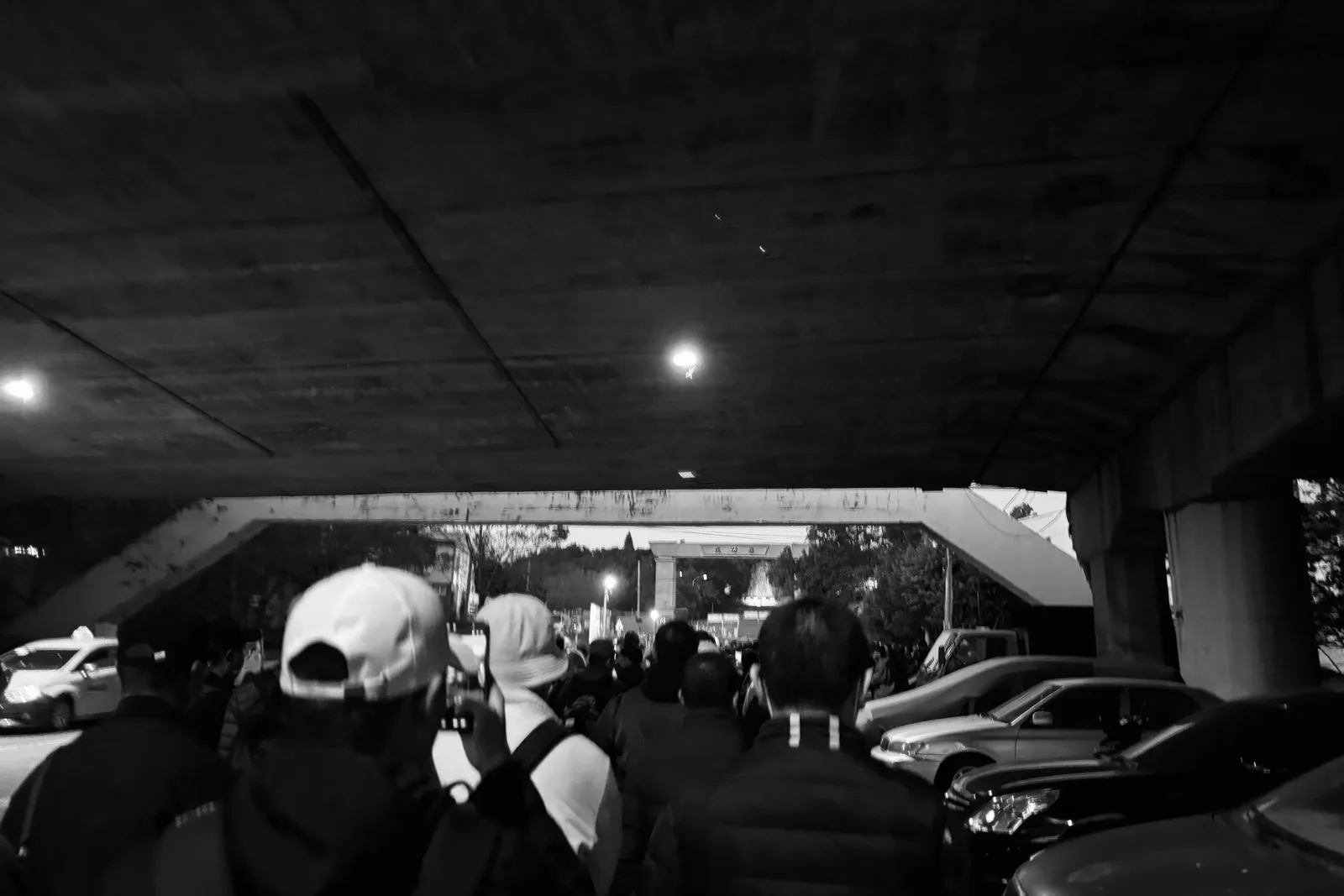
At the entrance to Chenggungling, there is a well-known highway overpass. On it, in thick red characters on a white background, stand the words: “The Road to Success” (走向成功之路). The irony is that the direction from which you can most clearly read that sign is the one you face when leaving Chenggungling.
I expected to feel a storm of emotions leaving the base — relief, anxiety, excitement, resentment — an urgent need to let it all out. Instead there was only stillness. So that’s it, then?
The train moved forward. Scenery drifted past the windows. People around me scrolled through their phones, each absorbed in their own world. None of us knew where we were heading. The one thing I knew for certain was that, not long from now, many more young men would walk through those gates — night after night, day after day.